Tampilkan postingan dengan label Restitution. Tampilkan semua postingan

Kamis, 20 Desember 2012

2nd Circuit Rules for the Met in a Bolshevik-era restitution suit

"Portrait of Madame Cezanne", Pierre Cezanne (1891)
Pierre Konowaloff has lost a bid to secure the return of some art confiscated nearly a century ago. Konowaloff is the successor in interest of a Russian art collector who had his art collection confiscated in the 1917 Russian revolution. The 2nd Circuit held the claim is barred by the act of state doctrine, upholding a 2011 dismissal of the claim in the Federal District Court for the Southern District of New York. In its simplest form, the doctrine protects the U.S. Executives dealings with foreign nations by requiring claimants like Konowaloff to seek a remedy with the state doing the expropriation. The doctrine states that separation of powers requires that federal courts not challenge the validity of decisions by recognized foreign sovereign governments.

In 1911, Ivan Morozov purchased the work. Morozov was a Russian art collector, and lost this work and another Van Gogh currently held by Yale University after the Bolshevik seizures during the Russian revolution. Konowaloff is the great-grandson of Morozov. The Soviet Union in 1933 needed funds and decided to deaccession (if I can use that term in this context) the painting. The paintings were purchased by Stephen Clark, an American who bequeathed the Cézanne to the MET and the Van Gogh to Yale University. Yale decided to initiate a declaratory suit, getting ahead of the lawsuit, and is still ongoing.

So the Bolshevik-era claim has been extinguished. One wonders though if the way courts treat the act of state doctrine in this context may be different from the ways it might treat foreign ownership declarations of other works of art. That's a question I don't have the answer to. It may be there are peculiar aspects of the doctrine. But on balance this seems like nations are given the benefit of the doctrine when it comes to situations where museums have long possessed these objects, but they aren't given the same advantages in other repatriation cases. That may be because of problems baked-in to the doctrine, or not. I'm not aware of any direct act of state doctrine argument which bends for claimant-nations, it seems primarily to assist current museums attempting to fend off suits arising from Nazi-era takings.

  1. Philip Boroff, Met Museum Sued Over Cezanne Painting Stolen by Bolsheviks From Collector, Bloomberg, December 8, 2010.
  2. Konowaloff v. Metropolitan Musem of Art 11-4338-cv (2nd Cir. 2012)

Selasa, 13 Desember 2011

A New Museum Position: Curator of Provenance

A Medallion looted during WWII
Geoff Edgers had a terrific piece over the weekend profiling Victoria Reed, curator of provenance at the MFA Boston. Her position was created in 2010, and is unique in the museum community. She is according to the piece the only curator of provenance at an American museum, a post which can put her in an uneasy position, recommending that the museum should not acquire objects with insufficient history.

Enter Victoria Reed, the MFA’s curator of provenance. Her job, which is almost as rare in the museum world as is the medallion, is to research works with questionable histories both in the collection and on the MFA’s shopping list. As a result, Reed’s other job is to break curators’ hearts. Through months of research, Reed traced the medallion to a museum in Gotha, Germany, that she knew had been looted during the Nazi era. With that information, the MFA’s jewelry curator, Yvonne Markowitz, put the brakes on its purchase. And in September, the Art Loss Register announced that S.J. Phillips Ltd., the dealer who had offered the medallion, would be returning it to the Castle Friedenstein museum.

This can't be an easy position to be in, but as more scrutiny attaches to museums, their collection, and their acquisitions, this kind of position will likely become more and more common. The market and dealers have not been adequately accomplishing this painstaking but necessary task, but perhaps they should be.

Paying for a position like this can be difficult given the funding climate for many museums. The piece notes that the position was funded by an MFA Boston donor, Monica S. Sadler, who stipulated that her position should not be cut from the museum's budget. So other benefactors to museums out there, if you are concerned with the practice at your local museum, give a gift with similar stipulations. Easier said than done of course, but all parties involved should be praised for undertaking an important piece of reform which really could continue to substantially change the importance of provenance research. The piece deals primarily with works of art and paintings, but a position like this which examines antiquities could have even more far-reaching consequences for repatriation and acquisition.
  1. Geoff Edgers, A detective’s work at the MFA, The Boston Globe, December 11, 2011, http://bostonglobe.com/arts/2011/12/11/detective-work-mfa/6iaei4YOQOj83s9u3YfDXO/story.html?s_campaign=sm_fb (last visited Dec 13, 2011).

Selasa, 26 Juli 2011

Repatriated Objects from the Getty in Naples


Over the weekend I traveled with a group from Amelia down to Sorrento and the Bay of Naples. On Saturday we went into Naples and visited what may be the most important Italian archaeological museum in Italy, the Naples National Archaeological Museum. It was every bit as stunning as advertised. A grand old beautiful shambling wreck of a museum in a beautiful mess of an Italian city, with the Farnese Bull, and the Alexander Mosaic, and much more. It was a lovely visit to one of Italy's very best museums. It was founded in the 1750s by Charles III of Spain, and houses a number of important works from nearby Pompei and Herculaneum, which had been rediscovered and excavated in the early part of the 18th century.

But on the way out, a sign indicating what exhibition rooms were open or closed stood out. We hadn't noticed it on the way in. I've posted the picture here, and even though it is too blurry to read, the red text at the bottom says 'Restituzione dal museo J.P. Getty', but the gallery was closed. One of our group asked (in Italian), why the gallery was closed, and was told apparently it was due to a lack of funding.

He asked, 'what objects were in the gallery from the Getty', and the museum employee responded that there was not enough funding for an inventory, probably meaning they did not have enough money to prepare a brochure. So which objects were meant to be displayed, the museum visitor can only guess at. Now I have no way of knowing if this is a typical case. Perhaps we caught the museum on a day where they were understaffed—though it was a Saturday. We paid our 8 euros each, though, and did our small part. There were a number of closed off areas, as you can perhaps make out in my amateur photograph, so there are other areas closed to the public.

Italy is currently enduring its own austerity measures, and like other nations which are cutting back, culture and heritage are some of the first targets. So perhaps in more prosperous times these objects will be displayed more regularly. But even with a good reason for the closing, even with a good reason for restitution, what good is a return if the objects can not be displayed? It will reduce the demand perhaps, but keep these objects hidden away, at least for our small group.


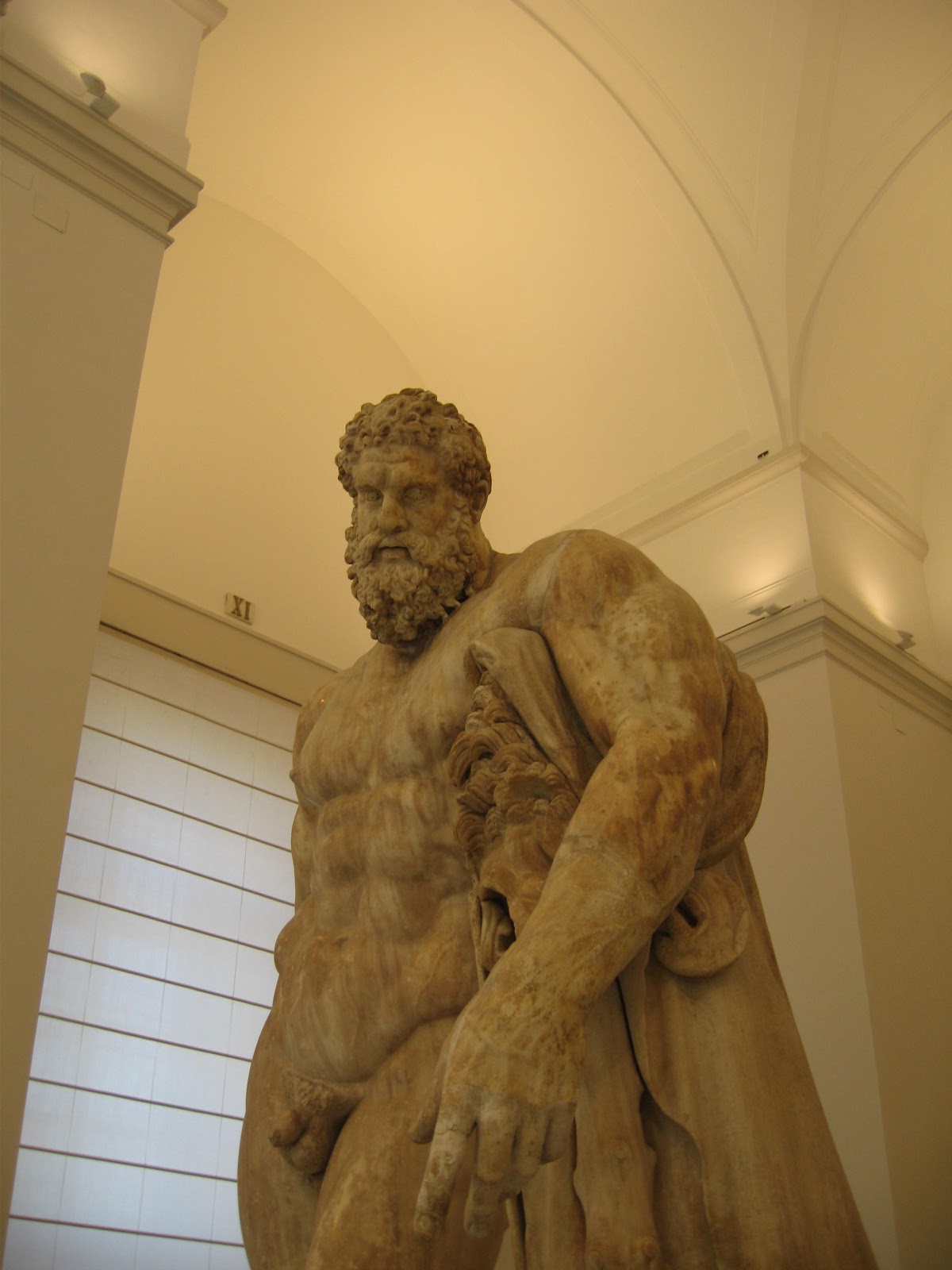
The museum was, for me, stunning. Whether the objects from the Getty (whatever they were) would have compared to the Farnese Bull, the Hercules at rest pictured here, or any of the stunning micro-mosaics can only be guessed at. But it is a striking irony that all of the work and time and effort spent repatriating objects from the Getty was wasted on this visitor, who took a plane, train, taxi, and bumpy ferry, walked the rainy streets of Naples to the Museum, and was still unable to see the objects 'in context' in Naples. This certainly does not justify for me the illicit and illegal trade in these objects. It does though I think crystallize just how vexing the antiquities trade, museums, and repatriation issues can be.

Senin, 30 Mei 2011

Kreder on Holocaust-Era Art Claims and Federal Executive Power

Prof. Jennifer Anglim Kreder has a new essay in the Northwestern Law Colloquy which examines some timely issues in Holocaust-Era art claims. From the Introduction:

Doctrines of judicial restraint in international cases take many forms, but they all have at their heart a concern about the proper role of courts, be they federal or state. This Article explores the proper role of courts in deciding state law conversion claims for art stolen or subject to forced or duress sale during the Nazi era. Many presume, incorrectly, that such claims must be precluded by separation of powers and federalism doctrines. This Article demonstrates the inaccuracy of such presumptions.

Selasa, 29 Maret 2011

The Getty Returns a Work to Goudstikker Heir Marei von Saher

The Getty has voluntarily agreed to return a work it purchased—in good faith they claim—in 1972. According to  Mike Boehm's report in the L.A. Times, the Getty stands as the first North American Museum to voluntarily return a work to the Heir of Jacques Goudstikker. The work, Landscape With Cottage and Figures, by Mieter Molijn, dates to the 1640s. It is unclear how the disputed painting came to light, but the return of this work stands in contrast to the ongoing dispute between von Saher and the Norton Simon:


The Norton Simon Museum's "Adam and Eve" also were among the Goudstikker-owned works the Allies repatriated to Holland after the war. But the Dutch government subsequently sold them to an heir of Russian nobility who claimed that his family, the Stroganoffs, had a prior claim on them, having owned them before they were seized by the Bolsheviks during the Russian Revolution. Goudstikker bought them at an auction in 1931, then lost them to the Nazis. Whether "Adam and Eve" had belonged to the Stroganoffs during the early 1900s is part of the dispute between Von Saher and the Norton Simon Museum. The museum's founder and namesake bought them from the Stroganoff heir for $800,000 in 1971; the museum has had them appraised at $24 million. 
In the "Adam and Eve" case, a federal judge in Los Angeles ruled in 2007 that Von Saher had filed her claim too late to meet the three-year statute of limitations for suing to recover allegedly stolen art, and that a 2002 California law suspending the statute of limitations for Holocaust-era art-restitution claims filed through the end of 2010 was unconstitutional because it intruded on the federal government's sole prerogative to set foreign policy and war policy. 
The U.S. 9th Circuit Court of Appeals agreed in 2009 that the California law was unconstitutional, although it directed the trial judge to reconsider whether Von Saher nevertheless has a legitimate claim under the regular statute of limitations. 
Von Saher has appealed to the U.S. Supreme Court in hopes of reinstating the voided state law. The high court indicated in October that it is considering whether to take up the case, but first it asked the U.S. solicitor general to file a brief giving the federal government's view. Kaye, the Von Saher attorney, said the brief hasn't been filed yet.
So the Getty has voluntarily returned the work to the dispossessed heir, and should be praised for doing the right things. Yet that decision surely was much easier given that the painting was never displayed. The Norton Simon has decided to fight to retain possession of its disputed works—which are more valuable, and have a much more complex history, touching both the Bolshevik revolution and World War II.

  1. Mike Boehm, Getty Museum: Getty Museum agrees to return painting looted by Nazis, L.A. Times, March 29, 2011, http://www.latimes.com/entertainment/news/la-et-getty-painting-20110329,0,2892909.story (last visited Mar 29, 2011).

Senin, 20 Desember 2010

Second Circuit Rules for MoMA

"Hermann-Neisse with Cognac"
Last Thursday, the Second Circuit Court of Appeals upheld a Federal District Court ruling denying the attempts by the late painter George Grosz to seek the return of three works currently held by the Museum of Modern Art in New York. The estate argued Grosz was forced to leave the works with his art dealer when the artist fled Nazi persecution in 1938.

In New York, the limitations period does not begin to run until a claimant demands, and is refused, a disputed work. So after that first request the claimant has three years to bring suit. In this case, the latest time in which that occurred was in 2005, while suit was not brought until April 10, 2010.


"Republican Automatons"
The Grosz estate argued that settlement negotiations were ongoing in 2005, and that under principles of fairness and equity (what the law calls equitable estoppel) the suit should not be time barred. So, an unsuccessful repatriation suit. The Met had declined to borrow at least one of the works in 2006 due to concerns about its provenance.

The disputed works were, Hermann-Neisse with Cognac, Self-Portrait with Model, and Republican Automatons.


Grosz v. Museum of Modern Art, (2nd Cir., 2010)

Jumat, 10 Desember 2010

The Met Sued in Bolshevik-era Restitution Suit

"Portrait of Madame Cezanne", Pierre Cezanne (1891)
The Met has been sued by Pierre Konowaloff over this work. The claimant argues the work was stolen from his great-grandfather during the Russian Revolution, Ivan Morozov. Morozov was a Russian textile merchant, who collected a number of works by Cezanne. His works were zeized in 1918, and Morozov's home was made a state museum.  This work was apparently purchased by Morozov in 1911, and he owned the work for seven years. In contrast, the Met has had the work for the last 50 years. The work was donated to the Met in 1960 by Stephen Clark, who purchased it from a gallery in 1933.

This suit, if successful, would really extend the limits of restitution claims further into the past to touch not just the Second World War, but the first one as well.

Konowaloff is currently defending a declaratory judgment suit brought by Yale University over the disposition of Vincent Van Gogh's "The Night Cafe". Yale is seeking a court determination that it is the rightful owner of that work, which would preclude a sale by the claimant.
  1. Philip Boroff, Met Museum Sued Over Cezanne Painting Stolen by Bolsheviks From Collector, Bloomberg, December 8, 2010, http://www.bloomberg.com/news/2010-12-09/met-museum-sued-over-cezanne-taken-by-bolsheviks-from-collector.html (last visited Dec 10, 2010).

Kamis, 09 Desember 2010

Embassy Cables Discuss Odyssey Marine, and a Nazi era Dispute

So the World is buzzing with all the revelations, mundane and otherwise, offered by the release of diplomatic cables via wikileaks. This has touched all manner of foreign and diplomatic relations, even cultural property and heritage issues. The Guardian has reprinted and summarized a series of recent cables which detail meetings between US officials and Spanish officials between 2007 and 2010. The various positions and points of concern related here really don't come as much of a surprise. What is perhaps heartening to note is the importance of these issues at the highest levels of international relations. Nations take these disputes very seriously.

It is certainly possible to over-emphasize the importance of these, but both parties certainly seem to have very different priorities. In a 2008 cable, Spanish Culture Minister Molina is concerned with the then-emerging dispute with Odyssey Marine, while the American Ambassador focuses on Spain's dispute with Claude Cassirer. As the embassy cable summarized,

The Ambassador stressed the USG's interest in direct discussions between the Spanish government and Claude Cassirer, the AmCit claimant of a painting by Camille Pisarro ("Rue St. Honore") in the Thyssen Museum. The Ambassador noted also that while the Odyssey and Cassirer claim were on separate legal tracks, it was in both governments' interest to avail themselves of whatever margin for manuever they had, consistent with their legal obligations, to resolve both matters in a way that favored the bilateral relationship. The minister listened carefully to the Ambassador's message, but he put the accent on the separateness of the issues. Molina said that no Spanish government could return the painting (if this is what the claimant wants). To begin with, while the minister presides over the board that manages the Thyssen Museum's collection, the minister could not oblige the board to return the painting without a (Spanish) legal judgment. The minister added that paying compensation, as the British government has reportedly done in a number of cases, also posed legal problems.

  1. Giles Tremlett, WikiLeaks cables: Art looted by Nazis, Spanish gold and an embassy offer, The Guardian, December 8, 2010, http://www.guardian.co.uk/world/2010/dec/08/wikileaks-us-spain-treasure-art (last visited Dec 9, 2010).

Selasa, 05 Oktober 2010

Will the Supreme Court Take Up Nazi-era Limitations Periods?

It might.  The U.S. Supreme Court has asked the Solicitor General to submit a brief on the issue of whether states can enact more permissive limitations rules when they may conflict with the foreign affairs doctrine.  Marei Von Saher has been pursuing her claim against the Norton Simon Museum over these two works by Lucas Cranach the Elder.  Von Saher is seeking certiorari with the Supreme Court—and the court has not granted review, it just wishes to hear the position of the federal government first, before deciding whether to review the case. 

The 9th Circuit Court of Appeals ruled earlier this year that California may not set aside special rules for Nazi-era claims because it conflicted with the federal government's ability to govern foreign affairs.  The claimant Marei Von Saher is the successor in interest to Jacques Goudstikker who bought the works in a 1931 auction in Berlin. The works remained there in Amsterdam until 1940 when the Nazis instituted a forced sale. After the war, Desiree Goudstikker reached a settlement with the Dutch government. She received some of her husband's inventory, but did not claim another set of works because that would have meant returning the purchase price received from the Germans.

The Dutch government transferred these Cranachs to George Stroganoff-Scherbatoff, the descendant of a noble Russian family who was thought to have lost the paintings to the Bolsheviks during the Russian Revolution.  Stroganoff-Scherbatoff sold these works to the Norton Simon Museum in 1971.  The 9th Circuit held first that California's special limitations rule for works looted during the Holocauset era, Sec. 354.3 conflicts with the foreign affairs doctrine.  Though it does not conflict with Executive Branch policy via the President, it does conflict with a power reserved to the Federal government, as California created a "world-wide forum for the resolution of Holocaust restitution claims". 

As a consequence, the claim was left to general limitations principles.  In California the Discovery Rule applies.  A claimant must bring her action within three years of discovering her claim.  This means actual discovery, but also when a reasonably prudent claimant should have discovered she had a claim, and the work first went on display in 1977. 

Yet even if the Supreme Court denies certiorari, Von Saher may have recourse under the new limitations period rules recently signed into law by Gov. Schwarzenegger, which attaches an actual discovery date on the beginning of an action, eliminating the sometimes difficult due diligence requirement.

Gov. Arnold Schwarzenegger last week signed into law a new art-theft bill that doesn’t mention the Holocaust but gives all claims seeking the return of stolen art from museums, galleries and dealers a better shot at withstanding the legal argument that they were filed too late. In suits over allegedly stolen art and other scientific, historic and cultural artifacts, the statute of limitations has been extended from three years to six, and the six-year clock starts running when the plaintiff first learned where the object was. Previously, a museum could argue that the clock began running when a work’s whereabouts was first publicized to the extent that someone seeking its return should have known about it then.

"Adam and Eve"  went on display in 1977 when the Norton Simon opened, prompting Los Angeles Times art critic William Wilson to write that he had experienced “a plain shock of unmitigated aesthetic fulfillment” upon seeing them. Museum founder Norton Simon bought the Cranachs from an heir of Russian aristocrats in 1971, and The Times first reported on them in 1972, saying they were among the industrialist's holdings that were being loaned to Princeton University for an exhibition.

Von Saher’s attorney, Lawrence Kaye, said Monday that her legal team, which includes E. Randol Schoenberg, the Los Angeles attorney who in 2006 secured the return of five looted Gustav Klimt paintings from the Austrian government, will wait to see whether the U.S. Supreme Court reinstates the voided California Holocaust art law. If it does not, she would be able to amend her suit to proceed under the state's new art-theft law. But the new law also would allow the Norton Simon Museum to use legal grounds other than the statute of limitations to press its argument that Von Saher waited too long to claim "Adam and Eve."

  1. Mike Boehm, Norton Simon's disputed 'Adam and Eve' getting closer look from Supreme Court | Culture Monster | Los Angeles Times (2010), http://latimesblogs.latimes.com/culturemonster/2010/10/art-adam-eve-holocaust-norton-simon-.html (last visited Oct 5, 2010).

Senin, 27 September 2010

Tension Between Museums and Nazi Spoliation Claimants

It should come as no surprise that there are tensions between museums and claimants over how to respond to claims for works of art stolen or appropriated by the Nazis.  Combine the general reluctance of many museums to allow transparency with the complicated stories of many works looted during World War II, and you have a recipe for ongoing disputes and mistrust.  This should explain why litigation may be a crude solution to many of these disputes, and why other nations—mainly in Europe—have done a better job at resolving these disputes than the United States. 

Robin Cembalest gives an overview for ARTnews, offering reactions from both sides.  The dispute stems from a basic disagreement of what kinds of wrongdoing should constitute loot.  Is a forced sale, or a sale under duress the same as outright theft?  Wesley Fisher, director of resaearch at the Conference on Jewish Material Claims Against Germany argues "It is embarrassing that countries that previously did not have such good records in this field, such as Austria, are doing a very good job . . .  And the United States is not doing as well as it was."  AAMD president Kaywin Feldman attributes the reluctance of some institutions to return objects to resources, "The real problem is that museums and claimants need help with research".  I think both of those sides offer some truth, though paying for increased provenance research would surely be less expensive than litigating a claim.  At least part of the difficulty stems from different ideas of what constitute a looted work, and perhaps a commission modeled after the United Kingdom's Spoliation Advisory Panel would offer a less controversial means of resolving these disputes.

  1. Robin Cembalest, Tensions are rising between the restitution community and U.S. museums over the proper way to handle Holocaust art claims, ARTnews, October, 2010, http://artnews.com/issues/article.asp?art_id=3073 (last visited Sep 27, 2010).

Rabu, 28 Juli 2010

Hungary Sued in US Over Nazi-Era Restitution Claim

One of the claimed works
"The Annunciation of Saint Joachim", by Lucas Cranach the Elder, 

Carol Vogel reports that the descendants of a Hungarian banker have filed suit in United States District Court over the disposition of a number of works of art.  The defendants include Hungary and a number of Hungarian museums.  The claimants are the descendents of Baron Mor Lipot Herzog, a jewish-Hungarian banker.  Vogel reports that most of the disputed works have been "hanging in Hungarian museums, where it was left for safekeeping during World War II or placed after being stolen by the Nazis and later returned to Hungary."  

I have not been able to track down the plaintiff's complaint just yet, so I cannot really comment on the substance of these claims.  Vogel reports that this suit raises new issues in that the claimants are seeking 40 specific works, but have also asked for an accounting of other works which may have once been owned by the Herzog family.  It seems curious that these claimants are bringing suit in the United States for these objects, jurisdiction must surely play an important role in the case, as will the timeliness of these claims.  It seems the claimants have been requesting these works for nearly twenty years.  A court in Hungary has ruled against the claimants in 2008, so it remains to be seen how an American court will be able to exercise jurisdiction over a dispute involving works once owned by a Hungarian, which are now on display in Hungary, and which have been previously ruled upon by a Hungarian court.  
A Renaissance portrait by Georg Pencz, recently restituted

We can contrast the litigation of these issues with the approach of the Spoliation Advisory Panel in the United Kingdom.  Rather than litigate these issues, the panel is charged with evaluating the claims of those who were dispossessed of their works of art during the Nazi era.  It recently handed over this work to the descendants of Baron Mor Lipot Herzog, and was recently sold for 5.6 million pounds at a Christie's auction.  

Reading Vogel's account, we are left wondering why exactly Hungary has refused to work with the claimants.  It appears they approached Hungary and asked to "split" the paintings under dispute but were refused.  These are important works, and one can understand why a State or museum would be reluctant to lose them.  Yet Vogel's account paints Hungary as a villain, unable and unwilling to account for Nazi-era works.  Is it really that simple?  Surely there must be a principled reason for Hungary refusing to return these works?  Anyone who has access to the complaint or to the recent Hungarian decision, please do drop me a line (derek.fincham "at" gmail.com).  
  1. Carol Vogel, Hungary Is Sued Over Large Holocaust Art Claim, The New York Times, July 27, 2010, http://www.nytimes.com/2010/07/28/arts/design/28lawsuit.html?_r=2&partner=rss&emc=rss (last visited Jul 28, 2010).

Senin, 26 Juli 2010

Profile of Howard Spiegler

Nancy Greenleese has a very fine profile of Howard Spiegler for Voice of America.  Mr. Spiegler has been an important advocate in a number of important art and antiquities restitution cases.  Because of this great work he received the 2010 ARCA Award for Lifetime Achievement in Defense of Art.

The audio profile includes highlights of Mr. Spiegler's remarks at the ARCA conference, as well as the comments of Chris Marinello of the Art Loss Register, and historian Marc Masurovsky.

You can listen to the profile here.
  1. Nancy Greenleese, Fighting for Art Justice, Voice of America, http://www1.voanews.com/english/news/american-life/Fighting-for-Art-Justice-99225324.html (last visited Jul 26, 2010).
Howard Spiegler at the 2010 ARCA Conference
(Urska Charney)


Selasa, 27 April 2010

Student Comment on Recovering WWII-Era Art from Russia

Michael Cosgrove has a student comment on remedies for the return of art from Russia:  Still Seeing Red: Legal Remedies for Post-Communist Russia's Continued Refusal to Relinquish Art Stolen During World War II, 12 Gonzaga Journal of International Law (2009).  From his introduction:

            When the Red Army entered Germany at the end of World War II, it seized 2.3 million objects including paintings, sculptures, and other works of art. At the time of this writing in 2009, the bulk of those objects are still in Russia. In addition to hundreds of thousands of pieces that belonged to German citizens and German museums the Russians hold paintings that the Nazis had stolen from all over Europe. Many of the works in question have been kept in locked rooms in the basements of museums since the end of the war. Although there were some encouraging signs that the art might be returned, or at least allowed to be displayed, with the end of the communist government, it does not appear that Russia is considering a large scale return of the art at this time. To the contrary, the Russian government has long held that the art is restitution for the destruction and theft of Russian art by the Nazis, and passed a law in 1998 that declares that the art is state property. This article explores the international legal remedy for procuring that art from the Russian government. "[U]ntil every one of those paintings, prints, sculptures, tapestries, and artifacts is returned, it will be impossible for us to walk through most of the world's museums and galleries without wondering if we are staring into the haunted face of the spoils of war." At the outset, a conclusion: favorable verdicts are obtainable, but the successful conclusion of litigation will only be the beginning of the exceedingly difficult task of enforcing a verdict against an obstinate and neo-nationalistic Russian government.

Selasa, 06 April 2010

Unsuccessful Restitution Suit by German Museum

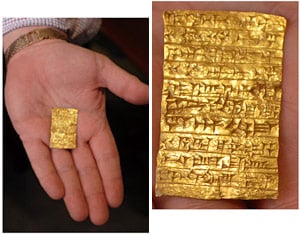
An ancient gold tablet excavated in Iraq from the site of an ancient Assyrian temple by German archaeologists in 1913
An Ancient gold tablet, excavated from Northern Iraq in 1913.

A German Museum has lost an action against Riven Flamenbaum to recover this ancient gold tablet that may be worth as much as $10 million.  You can read the opinion here, in Matter of Flamenbaum, File No. 328416. 

The tablet has quite a history.  It was unearthed in 1913 in Ashur, present day Qual'at Serouat by German archaeologists.  It was bound for a German museum, but World War I forced the ship carrying it to Portugal, where the object was stored until 1926.  In 1934 the tablet was put on display in the Vorderasiatisches Museum.  At the end of the war, in 1945 it was discovered the tablet was missing, perhaps looted by Soviet troops.  It is at this point that Flamenbaum—a survivor of Auschwitz—encountered the tablet, which he may have purchased on the streets of post-war Berlin for some cigarettes.  He took the tablet with him when he emigrated to New York in 1949.  He had no inkling of the object's value, after it had been apparently appraised for as little as $100 at one point.  The family contacted the Museum in 2006 after Flamenbaum's death, and the museum brought suit to recover the tablet. 

In New York, this action was within the statute of limitations because the period does not begin to run until an original owner demands an object and is refused—which in this case was 2006.  However Surrogate John Riordan held that the museum had waited too long to bring this claim under the doctrine of laches—an equitable doctrine which essentially posits that it wouldn't be fair to allow the claimant to regain title.  The court held the lack of any real effort by the museum to seek the return of the tablet was unreasonable.  Surrogate Riordan placed a good deal of weight on an apparent 1954 report of the object's location.  But the opinion does not offer any details of this report. 

The Museum had not really had possession of the tablet for very long, and had not made extensive efforts to contact post-war authorities or stolen art registries.  But of course it is not necessarily clear if those efforts would have even been successful.  Moreover, in some cases publicizing a theft in this way seems to run counter to the policy which underpins New York's Demand and Refusal rule.  If you publicize the theft, that recovery may make diligence less likely, and might encourage other possessors of objects with questionable histories to move objects to other jurisdictions. 

One wonder perhaps how much the underlying equities were a factor in the decision as well, with a seemingly-innocent Holocaust survivor acquiring the small tablet, without knowing its true value.

  
  1. Vesselin Mitev, German Museum Loses Attempt to Reclaim Artifact From Estate, New York Law Journal, April 6, 2010.

Selasa, 09 Februari 2010

Malevich Heirs and the Guggenheim Resolve Dispute

The Guggenheim has announced it has reached a settlement with the heirs of Kazimir Malevich.  At issue was this untitled work, created in 1916.  The piece was shown at an exhibition in Berlin in 1927 along with 70 other works, but the artist left the paintings behind before returning to the Soviet Union.  He was probably rightly concerned that his works would be confiscated if he returned them to the Soviet Union; and in fact they were later banned by the Nazis as well.  The work was purchased by Peggy Guggenheim in 1942. 

The terms of this settlement are confidential.  Malevich's heirs have recently been pressing claims to many works they believe were improperly obtained.  In 2008 they settled a claim for four works now in the possession of the city of Amsterdam. 

  1. Guggenheim and Malevich Heirs Resolve Painting Dispute, ARTINFO, February 8, 2010.
  2. Dave Itzkoff, Ownership Settled for Malevich Painting, The New York Times, February 9, 2010.

Selasa, 19 Januari 2010

9th Circuit Denies Limitations Appeal by Marei Von Saher


The 9th Circuit Court of Appeals has ruled on a claim over these two 500 year-old works by Lucas Cranach the Elder, Adam and Eve.  As I wrote back in 2008, this case presents some interesting issues of timeliness.  It grapples with the question of whether states may enact more beneficial limitations restrictions, allowing certain claimants to bring actions.  The claimant, Marei Von Saher is the successor in interest to Jacques Goudstikker who bought the works in a 1931 auction in Berlin. The works remained there in Amsterdam until 1940 when the Nazis instituted a forced sale.

After the war, Desiree Goudstikker reached a settlement with the Dutch government. She received some of her husband's inventory, but did not claim another set of works because that would have meant returning the purchase price received from the Germans.

The Dutch government transferred these Cranachs to George Stroganoff-Scherbatoff, the descendant of a noble Russian family who was thought to have lost the paintings to the Bolsheviks during the Russian Revolution.  Stroganoff-Scherbatoff sold these works to the Norton Simon Museum in 1971.  The 9th Circuit held first that California's special limitations rule for works looted during the Holocauset era, Sec. 354.3 conflicts with the foreign affairs doctrine.  Though it does not conflict with Executive Branch policy via the President, it does conflict with a power reserved to the Federal government, as California created a "world-wide forum for the resolution of Holocaust restitution claims". 

As a consequence, the claim was left to general limitations principles.  In California the Discovery Rule applies.  A claimant must bring her action within three years of discovering her claim.  This means actual discovery, but also when a reasonably prudent claimant should have discovered she had a claim.  Given that the museum acquired the work in 1971, this will surely make victory a difficult proposition. 

  1. Von Saher v. Norton Simon Museum of Art at Pasadena, --- F. 3d ---, 2010 WL 114959 (9th Cir. 2010). 
  2. Mike Boehm, Woman seeking return of looted art from Norton Simon Museum loses appeal - latimes.com, L.A. Times, January 16, 2010.
  3. Orkin v. Taylor