Tampilkan postingan dengan label Egypt. Tampilkan semua postingan

Rabu, 16 Januari 2013

Challenges for Preservation in Dahshour, Egypt


This Pyramid at Dahshour is being threatened
In Egypt at the Dahshour necropolis, modern cemetery expansion and looting are putting the much older pharaonic necropolis at risk. The AP reports that the locals are building new tombs, police are unable to enforce regulations and secure the site. But worst of all the piece speculates that the new Islamist regime holds little respect for the ancient past. Here's a flavor:

In the case of Dahshour, villagers say their cemeteries are full and authorities don't give permits or land for new ones. So they took matters into their own hands and grabbed what they insist is empty desert to erect family tombs. "The dearest thing for us is burying our dead," said Mohammed Abdel-Qader, a resident of nearby Manshiet Dahshour. "This land here is wide and flat, it's a valley. Where are the antiquities they talk about? ... We have no antiquities here."
. . .
The cemetery expansion is the most dangerous encroachment yet because of how close it comes to the Dahshour monuments, which are on the UNESCO World Heritage site list, Younes said. Moreover, Dahshour is largely unexcavated, since the area was a closed military zone until 1996. What remains buried is believed to be a treasure trove shedding light on the largely unknown early dynasties. "When you build something over archaeological site, you change everything. We can't dig in and know what is inside," Younes told The Associated Press. "This is the only virgin site in all of Egypt." 

 The story notes that the construction of new tombs, though illegal, may also be cover for looting. The piece paints a troubling picture. Consider the difficult time Egyptian officials must have had in protecting and preserving a site like this. They must weigh the concerns of angry local populations, be wary of the more dangerous antiquities looters, and also work to preserve the site.

Kamis, 01 November 2012

An Update on Looting in Egypt

Human Remains Exposed to the Elements at El Hibeh

After the revolution and the theft of 50 objects from the Cairo Museum in Egypt last year, the New York Times reports that looting continues in a systemic way. Of the stolen objects from the Cairo museum, 29 objects have been recovered, but many of the sites in the rest of Egypt are at risk to looters.
The number of illegal excavations and thefts has worsened to the point that groups are organizing heavy machinery to carry out extensive digs. “This wasn’t just someone taking their shovels and digging holes in the sand,” said Deborah Lehr, chairman of the Capitol Archaeological Institute at George Washington University, who has been charged with helping the Egyptian government protect its antiquities. “These were bulldozers, and gangs of men over a period of time.”

  1. Farah Halime, Revolution Brings Hard Times for Egypt’s Treasures, N.Y. Times, October 31, 2012, http://www.nytimes.com/2012/11/01/world/middleeast/revolution-brings-hard-times-for-egypts-treasures.html (last visited Nov 1, 2012).

Senin, 11 Juni 2012

Nemeth on strategic protection of cultural heritage

Does the citizen protection at the Cairo Museum
offer lessons for strategic protection of heritage?
Erik Nemeth makes an interesting point in a special contribution to the Chicago Tribune. Rather than just consider what museums or 'source nations' lose when objects are repatriated; why not consider the gain and strategic benefit returns can offer to the returning nation or museum. And what other benefits might occur during armed conflict if heritage sites are aggressively protected?

The political turbulence in Egypt, Libya and Bahrain has seen both looting of artifacts and destruction of monuments. Last year, citizens linked arms in front of the Egyptian Museum in Cairo with some success. This and other instances like it suggest potential for proactive protection of cultural artifacts, particularly in light of the U.S. ratification of the 1954 Hague Convention in 2009. Indeed, U.S. foreign policy can parlay risk to cultural property into diplomacy by insisting that military interventions, even when the U.S. is not engaged militarily, include a strategy for securing museums, monuments and sites of archaeological significance that along with tactical bombing avoids collateral damage. America might also assess objects that are likely targets for repatriation and consider offering their return as part of a strategy for relations with the nation of origin. If engaged in conflict — or even if not — an active interest in protecting the local cultural property would serve the purposes of garnering political goodwill and creating an opportunity for communication with the local government and potentially the insurgency.
  1. Erik Nemeth, Repatriating part of Saddam statue could promote diplomacy, Chicago Tribune, June 7, 2012, http://articles.chicagotribune.com/2012-06-07/news/ct-perspec-0607-artifacts-20120607_1_hiram-bingham-iii-artifacts-collateral-damage (last visited Jun 10, 2012).

Senin, 04 Juni 2012

Will US Attorneys Appeal after latest Ka Nefer Nefer setback?

A judge has dismissed the federal government's request to reconsider an earlier ruling dismissing the government's forfeiture request for the Ka Nefer Nefer mask currently on display at the St. Louis Art Museum. Rick St. Hilaire notes the U.S. Attorney must now make the decision whether to appeal the ruling on to the 8th Circuit. 


The problem with the government's initial case—at least in the district court's view—was the government failed to allege the particular circumstances under which a crime took place as the mask left Egypt. This problem can be examined by referencing recent case law broadening the principle that looted and smuggled objects are considered tainted when they leave their country of origin, even in the absence of direct evidence of wrongdoing. I'm thinking for example of the Barakat ruling in the English High Court which offered claimant nations a broader platform of potential laws with which a nation of origin can claim theft. 


But in this case the federal prosecutors had a difficult prospect as Egypt was unable to offer enough evidence establishing a crime had been committed. So despite the research the SLAM conducted when it acquired the mask in 1998, the government was unable to offer enough to convince a judge to forfeit the object and force SLAM to make its case. It is an open question whether the district court would have taken such rulings on board, likely not. But an appeals court is in a more favorable position to make broader inquiries in the law based on policy and foreign authority. 

Rabu, 04 April 2012

US Government's Claim to Ka Nefer Nefer Mask Dismissed

The Ka Nefer Nefer Mask will be staying in St. Louis for now
The Ka Nefer Nefer mask, subject of two lawsuits in federal court, seems likely to stay in St. Louis for the near future. On Monday the U.S. District Court dismissed the U.S. Government's forfeiture claim for the mask, as Rick St. Hilaire reported. The St. Luis Art Museum also has a parallel declaratory judgment action seeking to prevent the government from pursuing a forfeiture in the future.


You can generally read the tea leaves in the first few lines of a court opinion, and when the court wrote "the Government boldly states that it seeks the forfeiture of all rights, title and interest in a 3,200 year old Egyptian Mask . . ." you have a pretty good idea that the U.S. attorney was not able to convince the court to forfeit the mask. It most certainly was involved in a crime, yet the government was unable to allege enough "circumstances" surrounding the mask's journey from Saqqara in Egypt in 1952 to the antiquities market some time later.


The government undercooked its legal analysis of the illegal activities giving rise to a forfeiture in its first forfeiture attempt here. For now it may amend its complaint. If it does, it should perhaps note that Egypt has laws establishing ownership of its antiquities, and there is no set of circumstances under which this mask could have rightfully left Egypt. Perhaps noting that may lead to a different result this time around.

The Government cannot simply rest on its laurels and believe that it can initiate a civil forfeiture proceeding on the basis of one bold assertion that because something went missing from one party in 1973 and turned up with another party in 1998, it was therefore stolen and/or imported or exported illegally.

The court was concerned that the government failed to establish precisely how the mask became stolen property. There is plenty of precedent on point for this legal principle, but the lawyers for the government failed to include enough of it in the complaint. Now the U.S. attorneys will have to return to the drawing board and establish a firmer legal framework for the illegal removal of the mask from Egypt. Making the government's task more difficult, is the lack of evidence provided to them by Egypt establishing how and when the mask was stolen. As a consequence, if I was working on the case, I'd essentially treat it like an antiquities looting case. The theft itself is lost to history. But you don't need those facts, just enough to put the  burden back on the museum's case to show how far back its chain of title can go.

The museum will likely respond that it had no reason to believe the Aboutaam brothers were antiquities dealers to avoid in 1998. Was it established that they routinely dealt in looted objects in 1998, even if that can be established now? The SLAM conducted a search, and while certainly not ideal, it posed questions to officials in Egypt. For lots of background on the mask, see here.

We can ask whether the Museum should do the right thing, but the government attorneys had an opportunity to force them to and failed to allege enough concrete circumstances in its complaint to trigger what would have been a very uncomfortable forfeiture proceeding for the museum—one that coupled with reasonable public pressure exerted by Egypt would have certainly made continued possession of the mask in St. Louis untenable.


Lee Rosenbaum has posted a .pdf of the opinion:
  Ka-Nefer-Nefer Opinion

Rabu, 28 Maret 2012

Accounts of Looting at El-Hibeh in Egypt

"Looting is ongoing, there is no protection for the site"
 -Carol Redmount, archaeologist

Marco Werman of PRI talks with archaeologist Carol Redmount about ongoing looting at El-Hibeh in Egypt. In the interview which is embedded below Redmount notes that a criminal enterprise which has "mafia-like" characteristics is systematically looting the site. The leader of the operation is allegedly an escaped prisoner. No security is protecting the site.

I recommend clicking through to see a slideshow of discarded human remains and looted graves. Site protection is the first and probably most important step which can be taken here. Protections at Egypt's points of export and importing checkpoints cannot undo the damage being done here. The looters themselves are motivated by a vulnerable resource and economic hardship. You can follow this site on a facebook site Redmount has created to track the situation and offer assistance.

The facebook page notes a first-hand account from Redmount:

When I returned to Cairo from our dig house last week and our van passed the site heading for the eastern desert highway, we saw about ten men openly looting the mound and desert behind (we have pictures of some of them), with conveniently parked motorcycles nearby. One of our drivers took the same road this past Friday and reported that again numerous men were busy with wholesale looting of the site in broad daylight. This is an on-going crisis. They are destroying the site. The SCA officials have tried everything they could to get the looting to stop. Nothing seems to be having any effect. This is something police and security seem to be ignoring, turning a blind eye to, or worse. We started the Save Hibeh facebook page because we are at our wits end as to what else to do . . .

The solution is for Egypt's authorities to raise the level of security at this site and sites like it, or to enlist the assistance of other agencies from UNESCO or Italy's Carabinieri. We can all collectively pressure Egypt from afar to take these steps, but a nation controls the protection of its own heritage.

Our next-best option is to stop buying the shabtis and kinds of salable objects that come from sites like this without complete histories, adequately documented.
  1. Andrea Crossan, Egypt Looters Ransack Archaeological Sites PRI’s The World (2012), http://www.theworld.org/2012/03/egypt-looters-ransack-sites/ (last visited Mar 28, 2012).

Senin, 19 Desember 2011

The Fire at the L'Institut d'Egypte a "great loss"


One of the frustrations about writing about the protection of art and heritage is the biggest news items are often really grim, and there can often be little room for optimism. On Sunday the Institute D'Egypte caught fire and burned. The Institute was established in 1798 by the French, and held an estimated 200,000 volumes, including rare accounts of Egypt in the 18th Century. I must confess I had no knowledge of the Institute before yesterday, but because I, like many privileged folks in the developed world, have access to Wikipedia, I know it is an important building, and an important repository of information. Yet most Egyptians don't have that luxury. As Larry Rothfield points out, neither the protesters, nor the military seemed to know this was an important building containing books and manuscripts. Initial accounts describe troops throwing rocks down from the roof at protestors, and the protestors responding with molotov cocktails. It is not clear who started the exchange, but the result is clear. An important repository of knowledge has been destroyed.

The background for the destruction, which may or may not have been intentional, are rising tensions once again in Cairo near Tahrir Squar. The best current accounts of the destruction and attempts to rescue some of the volumes is the Ancient World Bloggers Group. And so there is at least some room for optimism. Many of the protesters were seen carrying books to a nearby church to attempt to salvage some of them. Also, William Kipycki, Tield Director of the Library of Congress--Cairo, Egypt at the U.S. Embassy photographed the stamps used at the Institute so antiquarian book buyers and sellers will be on the lookout.

Employees at the U.S. Embassy and the American University in Cairo have been reported as offering assistance to do what can be done to minimize continued destruction.

From the AP:
Zein Abdel-Hady, who runs the country's main library, is leading the effort to try and save what's left of the charred manuscripts. "This is equal to the burning of Galileo's books," Abdel-Hady said, referring to the Italian scientist whose work proposing that the earth revolved around the sun was believed to have been burned in protest in the 17th century. Below Abdel-Hady's office, dozens of people sifted through the mounds of debris brought to the library. A man in a surgical coat carried a pile of burned paper with his arms carefully spread, as if cradling a baby. The rescuers used newspapers to cover some partially burned books. Bulky machines vacuum-packed delicate paper. At least 16 truckloads with around 50,000 manuscripts, some damaged beyond repair, have been moved from the sidewalks outside the U.S. Embassy and the American University in Cairo, both near the burned institute, to the main library, Abdel-Hady said. He told The Associated Press that there is no way of knowing what has been lost for good at this stage, but the material was worth tens of millions of dollars -- and in many ways simply priceless.

Kamis, 11 Agustus 2011

Not Just Bad Paperwork

In July, Immigration and Customs Enforcement announced that it had indicted four men and dismantled an entire antiquities smuggling network. The indictments in what I'll call the "Lewis Smuggling Network" alleged that the four men sent objects from Egypt to Dubai before coming to America. The case brings to mind another similar kind of prosecution in which an individual was accused of not properly declaring the history and value of antiquities being imported into the United States. The case offers a number of similarities to an older case involving customs declaration.

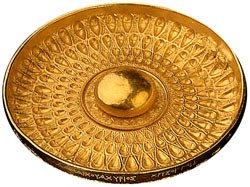
In 1980 a gold phiale, called the golden phiale of Achyris, pictured here, probably of Sicilian origin, was sold by a collector in Sicily to another collector and coin dealer, who in turn sold the work to William Veres, an art dealer based in Zurich, Switzerland (it gets confusing and we still haven't reached the ultimate endpoint). The phiale was offered to Robert Haber, a New York art dealer. Haber acted as a middle man in an eventual sale to Michael Steinhardt for $1.2 million. In December 1991, Haber flew to Switzerland to retrieve the phiale. Upon his return to New York, the customs forms declared the work’s country of origin as Switzerland and its value a mere $250,000. Why did the customs forms lie? To hid and disguise the object's history.

In 1995, Italy began asking for formal assistance, and the Federal government intervened with a civil forfeiture action. A federal magistrate in New York issued a warrant for the seizure of the phiale from Steinhardt. The U.S. government then instituted a civil forfeiture action against the phiale in federal district court in New York. The district court held that the phiale was subject to forfeiture under 18 U.S.C. § 545. The importation of goods “by means of false statements” is prohibited by 18 U.S.C. § 542 and renders them subject to forfeiture under 18 U.S.C. § 545. The court found that falsely listing the work’s country of origin as Switzerland tainted the importation process and violated § 542. Steinhardt defended on the grounds that he had no knowledge that the object was looted or stolen. The court disagreed, finding that 18 U.S.C. § 545 does not afford an innocent owner defense. Steinhardt appealed the district court’s decision. The Second Circuit affirmed on the grounds that the misstatement of the phiale’s country of origin was material and thus subjected it to forfeiture under 18 U.S.C. § 545.

There are some differences between Steinhardt and the pending case against Mousa Khouli (Windsor Antiquities, NY), Salem Alshdaifat (Holyland Numismatics, West Bloomfield MI), Joseph A. Lewis, II (collector of Egyptian antiquities), and Ayman Ramadan (Nafertiti Eastern Sculptures Trading, Dubai).

This recent case has the Federal prosecutors pursuing charges against the dealers and collector in this case. They are not pursuing the object by itself, but rather they have a case against the whole network. Irrespective of whether Steinhardt, and his intermediary should have known and asked more closely about what they were buying, there were false statements made on the importation documents, just as false statements were alleged to have been made in this recent sting. Both Steinhardt and Lewis held esteemed positions, with power and influence. In Lewis' case however, the Federal Prosecutors feel they have a much stronger case, with information on the entire smuggling and looting network, not just an isolated false statement on an importation document. In any event, neither Lewis nor Steinhardt will likely consider their cases bad paperwork. Misrepresenting the value and nation of origin is a deliberate attempt to circumnavigate heritage law. And if the government can make its case, there may be some real custodial sentences imposed.

Rabu, 03 Agustus 2011

Why did the Met Return Objects to Egypt?

A small bronze dog, one of the objects returned to Egypt
You can read what a couple of lawyers think in Marlon Bishop's story for WNYC:

The Metropolitan Museum of Art has returned 19 objects to Egypt originally found in King Tutankhamun's tomb. Last November, the Met agreed to give back the artifacts after an internal museum investigation determined it had no right to the antiquities — mostly non-museum quality pieces, ranging from small fragments to a tiny bronze dog — in the first place. On Tuesday, the museum said it had shipped the objects to Egypt.


  1. Marlon Bishop, Metropolitan Museum Returns Antiquities Found in King Tut’s Tomb to Egypt WNYC (2011), http://culture.wnyc.org/articles/features/2011/aug/02/met-museum-returns-antiquities-egypt/ (last visited Aug 3, 2011).

Jumat, 15 Juli 2011

"Groundbreaking" Antiquities Smuggling Ring Investigation

 Immigration and Customs Enforcement (ICE) announced yesterday that it has for the first time "dismantled" an antiquities smuggling network operating in the United States. Charges have been brought against individuals before, but this is appears from the indictment to be a pretty complete looting network, operating in the Middle East and the United States, which has been uncovered. According to the federal indictment four men have been charged with smuggling antiquities into the United States. It alleges that four men operated a smuggling operation which sent objects from Egypt to Dubai and its freeports and on to the United States. The federal agents also note that there was money laundering involved here, perhaps a tangible case implicating organized criminal activities to antiquities smuggling.

Dubai has freeports, much like Switzerland does. These are special areas which allow for the ease of international commerce, but can also be a haven to looters and smugglers. Giacomo Medici of course operated a very posh looted antiquities showroom from a Swiss freeport for many years. As the tension and unrest in many Middle-Eastern countries emerges, will Dubai become a focus for antiquities investigations? A haven for looters? I would suspect that Dubai will be far more willing and able to police and investigate on the looting of objects and stolen artifacts. I have a PhD colleague who currently works in their copyright enforcement force, and I would imagine that if nations ask for enforcement assistance from Dubai, they will likely receive it.

Windsor Antiquities booth in Manhattan, via WSJ
The investigation began when ICE Special Agent Brenton Easter and his team were looking for a terracotta head which was uncovered in Iraq in 2000, and the investigation uncovered an international smuggling ring. This is an example of what appears to be a very successful operation which has targeted all of the individuals in the ring, including the conduit from the thieves or looters in the Middle East, "the broker", "the individual providing false provenance", and "the end-all collector". One of the objects, pictured here was a Greco-Roman-style Egyptian sarcophagus which might be worth as much as $2.5 million.

The indicted men are Mousa Khouli (Windsor Antiquities, NY), Salem Alshdaifat (Holyland Numismatics, West Bloomfield MI), Joseph A. Lewis, II (collector of Egyptian antiquities), and Ayman Ramadan (Nafertiti Eastern Sculptures Trading, Dubai).
  1. ICE makes arrests and seizes cultural artifacts stolen from Egypt, (2011), http://www.ice.gov/news/releases/1107/110714newyork.htm (last visited Jul 15, 2011).
  2. Keith Johnson, Alleged Antiquities Smugglers Busted, wsj.com, July 15, 2011, http://online.wsj.com/article/SB10001424052702304223804576446313624549304.html (last visited Jul 15, 2011).
  3. Kiran Khalid, Feds: Global antiquities smuggling ring dismantled CNN (2011), http://edition.cnn.com/2011/CRIME/07/15/new.york.antiquities.smuggling/ (last visited Jul 15, 2011).
  4. Feds accuse 4 of smuggling Egyptian artifacts, Reuters (2011), http://newsandinsight.thomsonreuters.com/Legal/News/2011/07_-_July/Feds_accuse_4_of_smuggling_Egyptian_artifacts/ (last visited Jul 15, 2011).
  5. Kate Taylor, Federal Authorities Charge 4 People in Antiquities Smuggling, The New York Times, July 14, 2011, http://www.nytimes.com/2011/07/15/arts/design/federal-authorities-charge-4-people-in-antiquities-smuggling.html?_r=1 (last visited Jul 15, 2011).

Jumat, 06 Mei 2011

Footnotes

Häuser mit bunter Wäsche (Vorstadt II), by Egon Schiele
  • The Leopold Museum in Vienna is deaccessioning a cityscape by Egon Schiele to raise the money to pay the settlement to the heirs of Lea Bondi Jaray over the disposition of Portrait of Wally.
  • A 500 year-old Nuremberg Chronicle has appeared in Salt Lake, it had been gathering dust in an attic for decades, or so the undisclosed seller has claimed. One wonders if the actual story is a good deal more complicated.
  • A review of a new human history of the Mediterranean notes the study of the island-city of Motya in Sicily has been delayed by looting: 
Motya is just four kilometres square, yet only five per cent has been excavated to date. Archaeological investigations collapsed in 1987 owing to Mafia complicity in pilfering antiquities. In the nearby Sicilian town of Marsala (famous for its fortified wine) a small museum nevertheless displays artefacts. Marsla is incidentally named after the Arab Mars al Allah, "Harbour of God", after the Saracen invasion of the western Mediterranean in 831.
Here’s a list on which most Egyptologists agree: Consult with local and international agencies and specialists to develop and implement long-term management plans. Train on-site inspectors and give them greater responsibility. Design better security for sites and museums. Allocate more money for site conservation and documentation. Take a strong stand against commercial and political interests that threaten the monuments.

Kamis, 24 Maret 2011

Protecting Giza from Looters

Giza
"We are paying the price for a greedy, insatiable and unregulated market."

So argues Sarah Marei, an antiquities inspector in Egypt. She describes firsthand the attempts to protect sites in   Egypt:


Under normal circumstances the tourist police are responsible for guarding Egypt’s rich ancient history, from monasteries to temples, synagogues to mosques. But the police presence vanished in the revolution and has yet to return to the sites. The individual initiatives on the part of site inspectors and the townspeople from the remote areas is often the only current protection afforded to some of the world’s most unique and magnificent monuments. 
We continue to work everyday on the makeshift salvage operation in Giza. Volunteers regularly turn up and, as we work, stories are exchanged about the looting where gangs of armed men attacked and shot the guards and plundered the site. 
The work we are conducting is not only physically draining but also emotionally exhausting. My anger is initially directed at the looters and my thoughts keep returning to the same question: why are these criminals, who are Egyptians, looting their own history and their nation’s pride in order to sell it? Only if they stand to gain substantially would they go as far, feeding a market that is standing ready and prepared to amply reward them for their troubles; the better the object, the bigger the reward. 
No indication of the market for antiquities is clearer than in the selection of the sites targeted by the looters in the past few months in Egypt. The overwhelming majority is Pharaonic, followed by Islamic, with Coptic and Jewish so far remaining untouched. We are struggling to protect our sites, facing armed men while we have nothing but sticks, because of a demand from personal collections (both inside and outside Egypt) and from rival institutions seeking a competitive edge.
There's justifiable anger and frustration in the account, and familiar groups to blame: the looters and an unregulated market.

  1. Sarah Marei, Tales from the Egyptian revolution | The Art Newspaper, The Art Newspaper, March 24, 2011, http://www.theartnewspaper.com/articles/Tales+from+the+Egyptian+revolution/23394 (last visited Mar 24, 2011).

Kamis, 17 Maret 2011

U.S. Initiates Forfeiture

The Mask on Display in St. Louis
As expected the United States has initiated a civil forfeiture action over the Ka Nefer Nefer mask purchased by the St. Louis Art Museum in 1998. The government holds a number of important advantages in these forfeiture proceedings, which is why the Museum brought a suit last month to preclude a forfeiture, based on a lapsed five-year limitations period. As the government's complaint explains, the mask was professionally excavated, so this is not a case of looting and destruction of context. Rather the mask was either stolen later or was given to one of the archaeologists working at the site.


The government's filing outlines what it suspects happened next: that the mask was stolen sometime between 1966, when it was shipped off to Cairo for an exhibit, and 1973, when the Egyptian Museum in Cairo ran an inventory and discovered it missing. Box number 54, in which it had been packed, was empty. 
In 2006, Egyptian officials learned the St. Louis museum had bought the mask from Phoenix Ancient Art, in New York. 
The museum has said it thoroughly researched the mask's ownership history before buying it, and was given no indication that there were questions about how it arrived in the U.S. 
The museum's research showed the mask was part of the Kaloterna private collection during the 1960s, before it was purchased in Switzerland by a Croatian collector, Zuzi Jelinek, who then sold the mask to Phoenix Ancient Art in 1995. 
It also maintains in its lawsuit that the government's statute of limitations for seizing the mask has expired.


  1. U.S. demands art museum hand over Egyptian artifact | Reuters, Reuters, March 16, 2011, http://www.reuters.com/article/2011/03/17/us-museum-mask-idUSTRE72G06E20110317?feedType=RSS&feedName=domesticNews (last visited Mar 17, 2011).
  2. Jennifer Mann, Government sues to seize St. Louis museum's mummy mask, St. Louis Post-Dispatch, March 17, 2011, http://www.stltoday.com/news/local/metro/article_98d72244-9976-5b8a-a73d-5c211c6a771b.html (last visited Mar 17, 2011).

Senin, 07 Maret 2011

Armed Attack on Antiquities Storehouse in Egypt

After the resignation of Zahi Hawass, there are reports of looting and theft including one disturbing report from Kafr el-Sheikh on Saturday:

Forty armed men attacked an antiquities warehouse in the northern Egyptian city of Kafr el-Sheikh on Saturday, shooting at warehouse security men and injuring several, state news agency MENA said. The attack is the second attempt to rob Kafr el-Sheikh's Tal al-Faraeen (Hill of the Pharaohs) antiquities warehouse since Jan. 25, the first day of the nationwide protests that toppled President Hosni Mubarak on Feb. 11.
...
The warehouse doors were destroyed as were display cases, MENA cited the Head of the Central Department of Lower Egyptian Antiquities Mohamed Abdel Maksoud as saying. Some of the attackers had been caught, while others had escaped, he said.

In a statement on his blog yesterday, Hawass confirmed these reports.

So what concrete steps can be taken now? Chris Marinello and the Art Loss Register have pledged their support, but their efforts require the authorities in Egypt to notify them of the specific objects which have been taken. Larry Rothfield argues that while public statements are a necessary step, they have no real effect. He argues institutions should call on their members to help identify and reclaim missing objects, and to pool resources to hire locals and security personnel to protect storehouses and sites. He also suggest financial and logistical support could be provided by the United States to help Egyptians secure and guard their sites.
  1. Forty armed men attack Egypt antiquities store-MENA, Reuters, March 5, 2011, http://af.reuters.com/article/egyptNews/idAFLDE7240E820110305 (last visited Mar 7, 2011).

Kamis, 03 Maret 2011

Why Get so Worked up over the Ka Nefer Nefer Mask?

I'm a bit puzzled by all the criticism being directed at the St. Louis Museum of Art. The looting of antiquities destroys archaeological context, but the Ka Nefer Nefer mask was not looted. Both the Museum and those who would have the mask returned to Egypt agree that the mask was professionally excavated in 1952. Egypt has claimed the mask was stolen from a storehouse at some point, while the Museum argues it researched the provenance and found no information to indicate it had been looted. One may argue that the acquisition procedures of museums are generally lacking. And we can certainly criticize the imperfect procedures implemented by the museum to ask questions of the mask in this case—though they did ask some questions in good faith. Though there was no export permit for the mask, but I'm not sure that justifies the criticism of the museum for its suit against the federal government. The museum is only asserting that the Federal government sat on its hands and waited too long to bring a forfeiture claim. This is a perfectly reasonable cause of action, particularly given the enormous benefits to the government and the claimant when a civil forfeiture is brought.

If you are upset that no claims were brought earlier, why not criticize the U.S. government for waiting so long to bring a forfeiture proceeding? I think one of the frustrating things about these repatriation issues are what I'd call the tone deaf nature of much of the rhetoric irrespective of the merits of the claims. This claim is not the same as every other repatriation claim, they all have their strengths and weaknesses. And though I'd agree that many objects need to go back, not all of them do. Universal repatriation should not be the preferred remedy. The Museum here certainly could have checked closer into the history of the mask, but Egypt also didn't realize the mask was missing. As Mark Durney pointed out, this might be a good reason for renewed emphasis on documenting objects which are in storage. If you don't, it will be difficult to leverage the trade into ending the sale of objects completely, and that argument loses persuasiveness when the same rhetoric is used for each and every dispute, irrespective of its strengths and weaknesses.

Kamis, 17 Februari 2011

"The mask was not excavated in Missouri"

Catherine Sezgin interviews Ton Cremers for the Online Journal of Art Crime and asks about the Ka-Nefer-Nefer mask. He is named in a suit by the St. Louis Art Museum to prohibit U.S. Attorneys from bringing a forfeiture action for the object. On the Museum Security Network he argued:


There is NO doubt whatsoever that this mask was stolen from a storage is Saqqara. One does not need to be suprised that the infamous Aboutaam brothers were the ones selling this mask. They are 'renowned' for trading in dubious antiquities without any provenance. In this case they just made up a fake provenance: supposedly the mask had been part of a Swiss private collection. Yes, Switzerland again...

Rabu, 16 Februari 2011

St. Louis Art Museum Sues the United States to Preclude a Forfeiture

The Ka Nefer Nefer Mask, acquired in 1998 by SLAM
The St. Louis Art Museum (SLAM) has sued the federal government to preclude it from initiating a forfeiture claim against the Ka-Nefer-Nefer mask. The museum was approached in January by several U.S. attorneys in January, who indicated an intention to bring a forfeiture action against the mask. Civil forfeiture was the legal mechanism under which the Portrait of Wally litigation and subsequent settlement emerged. It is a powerful tool for claimants, which uses the resources of the federal government, and a favorable burden of proof, to pursue claims for objects which may have been looted or stolen.

But in this case, rather than waiting for the forfeiture action, the museum has decided to try to preclude a suit by the U.S. attorneys, arguing that from December-January of 2005-06, the U.S. was a party to several communications regarding questions with respect to the history of the mask. They use as examples, posts and emails sent by Ton Cremers, of the Museum Security Network. He sent at least two emails to Bonnie Magness-Gardiner of the FBI, INTERPOL, as well as James McAndrew at Immigrations and Customs Enforcement (ICE). The Museum's complaint quotes emails from Cremers, which were published on the Museum Security Network:


  1. “So I should think that if the Egyptian Government lodged a complaint or request with the USA Government and the FBI Crime Team (to which I am copying this), then the Museum would be obliged to answer the questions.”  
  2. “The FBI is just waiting for Egypt to file a complaint.  A [sic] soon as Egypt files a complaint [sic] the FBI is expected to act.” 
  3. “Maarten Raven, a Dutch archaeologist, saw the mask in the Saqqara and is VERY positive that the mask in the SLAM [Museum] is the same as . . .the one stolen in Saqqara . . . .


The SLAM argues in the complaint that the relevant U.S. government officials had knowledge of the potential claim over five years ago, and the five-year statute of limitations period has expired under 19 U.S.C. § 1621. A court will decide whether these emails, and queries the Museum sent to INTERPOL in the 1990's about the mask are sufficient to have given the U.S. government actual or constructive knowledge of the potential claim. The Museum seeks a declaratory judgment under the Tariff Act that the action is barred by the statute of limitations.

Even if successful, this suit would only preclude a suit by the U.S. government. It would not bless the circumstances surrounding the acquisition of the mask. The mask was acquired in 1998 by SLAM from Phoenix Ancient Art for a reported $500,000. The Museum has attempted to demonstrate its diligence in a number of ways when it acquired the mask.

  • It sent a letter to Mohammed Saleh, the retired director of the Cairo Museum asking about the mask or the existence of similar objects. 
  • The Museum contacted the Art Loss Register, INTERPOL, and the International Federation of Art Research.
  • In 1998"counsel for the Museum requested a Swiss attorney to conduct a background investigation of Phoenix, its owners, and Jelinek.  Museum counsel received responses from the Swiss attorney on February 18 and March 31, 1998, confirming a Suzana Jelinek resided at the address provided by Phoenix, and confirming Phoenix's company existence, Dun & Bradstreet rating, and that there were no liens or encumbrances on business property belonging to Phoenix."
  • The Museum also sent a letter to the Missouri Highway Patrol requesting a search of the Interpol database.
So these are efforts to look at the history of the object, but certainly are not the best efforts. The Museum did not contact the Supreme Council of Antiquities or the Culture Ministry. The SLAM has told the public and Egypt that they would return the mask to Egypt if they were presented evidence that the mask was looted or stolen, yet Egypt has not presented this evidence. We know that the mask was acquired by the Museum in 1998, and was excavated in 1952. Both Egypt and the Museum have very different versions of the subsequent history of the mask. We are not certain what happened in the intervening years. But given what we know about the antiquities trade we have strong suspicions. The Museum argues the U.S. government has waited too long to pursue its claims that the object was stolen. 

  1. Joe Harris, Museum Sues USA Over Mummy Mask, Courthouse News Service, February 16, 2011, http://www.courthousenews.com/2011/02/16/34223.htm (last visited Feb 16, 2011).
  2. Jennifer Mann, Art museum sues to keep Egyptian mummy mask, St. Louis Today, February 16, 2011, http://www.stltoday.com/news/local/crime-and-courts/article_6a5937bc-0ea6-50ca-94ab-aa45697af009.html (last visited Feb 16, 2011).

Senin, 14 Februari 2011

Protesting Zahi Hawass

Antiquities Graduates Demand Employment (AP Photo/Khalil Hamra)
Demonstrators in front of the Supreme Council of Antiquities in Egypt are demanding Antiquities Minister Zahi Hawass resign:

The demonstration in a leafy enclave of Cairo was one of many protests and strikes that have sprung up in Egypt as people voice their grievances for the first time after Mubarak's heavyhanded reign over the last three decades.
The archaeologists' protest was also deeply personal, with protesters saying Hawass was a "showman" and publicity hound with little regard for thousands of archaeology students who have been unable to find work in their field.
"He doesn't care about us," said 22-year-old Gamal el-Hanafy, who graduated from Cairo University in 2009 and carried his school certificates in a folder. "He just cares about propaganda."
Hawass has maintained that his first love is Egypt's heritage, not himself, and that courting publicity raises the national profile.
The rally was raucous but peaceful. Several soldiers blocked protesters from entering the Supreme Council of Antiquities building in the Zamalek district on an island in the Nile that was largely spared the chaos that gripped Cairo. An armored personnel carrier parked in the street, a helmeted soldier poking out of a hatch.
The minister did not appear, and a roar of disapproval swept the crowd when someone said he had slipped out the back door. Then there was a rumor, unconfirmed but no less damaging to his image, that his car had clipped a pedestrian. The protesters dispersed at dusk, and promised to return.
The graduates said the antiquities ministry had offered them three-month contracts at 450 Egyptian pounds ($75) a month, hardly enough to survive. They noted that Egypt's tourism industry is a major foreign currency earner, and yet it was unclear how exactly the government was spending the income.
A foreign tourist spends up to 160 Egyptian pounds ($27) to visit the pyramids of Giza and descend into a tomb there, said 25-year-old Said Hamid. Multiply that, he said, by the thousands who used to visit daily until upheaval drove away foreign visitors and plunged the lucrative industry into crisis. . . . 
 These protests come after Zahi Hawass has revealed that 18 objects had been removed from the museum, though some may have been returned.

Hawass is a showman. He has garnered a great deal of attention, and also raised the profile for Egypt's heritage, and its calls for repatriation. But in the new Egypt, will that approach still be suitable? I can understand the frustration of recent graduates, angry that they are paid very little. How will this shape the relationships Egypt has with foreign archaeologists?
  1. The Associated Press: Protesters target Egypt's antiquities chief, February 14, 2011, http://www.google.com/hostednews/ap/article/ALeqM5gNv6IKRhurEYPmjAzVk86a0tsX8g?docId=d818e386afeb449d988b51bc767e96d7 (last visited Feb 14, 2011).

Jumat, 04 Februari 2011

Firsthand Report of Looting in Saqqara

The step pyramid of Djoser at Saqqara
There are a number of conflicting reports emerging from Egypt, and as evacuated members of foreign archaeological missions arrive home, we are learning more about what took place in the chaos last weekend. Zahi Hawass is reporting on his website that sites are being protected and that reports of rumors of looting at places like Saqqara are not true. Yet Lee Rosenbaum has been forwarded a firsthand account from a French archaeologists that describes looting last weekend:


The French Archaeological Mission at Saqqara has just left Egypt yesterday and arrived safe today. As most of you are in lack of direct information concerning what happened there, I will try to tell you in brief what I saw. 
On Saturday, the taftish [on-site officer from Egypt's Supreme Council of Antiquities] asked us to stop the work, because the police were not in the capacity of protecting us anymore. In the afternoon, we could see that the police at the police station at the entrance of the resthouses was gone and had left us alone. That is when it all began: Robbers from Saqqara and Abusir became aware of this and they began to spread in the gebel [mountainous desert].

The first afternoon and night, they mainly attacked places which were secured with locks. They broke them and went inside. Most of the time, they destroyed what they saw and not robbed anything, trying to find "treasures." These are not well organised robbers but, mainly, young people from 10 to 20, very probably looking for gold. That is why, when they saw blocks of stone, they most of the time left them, or destroyed them in order to find what was underneath.

I could see them with my eyes the day after, when we made a tour in the gebel with the army. Around 5 p.m., when the sun was still not down, at the muslim cemetery of Abusir, I counted more than 200 young men, excavating in front of us, ready to flee if the army would come down. A tank of the army was there, but they kept on digging. The soldiers were not numerous enough to do anything else than showing they were here. And when we went back, they probably came back in the highs. They were laughing and throwing stones at us. 
. . .
After three days, more and more soldiers arrived in Saqqara and secured more and more of the area. The worse days were Saturday and Sunday. It looks like the army is now securing most of the area, and they made clear that anyone taken would be taken to jail. Hope it works.

Senin, 31 Januari 2011

Reports of Looting and Theft throughout Egypt

An Egyptian Soldier guarding the Cairo Museum
Like many of you I am following the reports from Egypt with great interest. There is a flood of information on the revolution generally, and also a lot of specific information about the destruction over the weekend at the Cairo Museum.

The situation at the Egyptian National Museum in Cairo seems to have stabilized, with soldiers arresting fifty men who have attempted to break in to the museum Monday. Yesterday Zahi Hawass faxed a report, which was posted on his blog.

 Now reports are emerging about damage and thefts at sites elsewhere in the country. Much of it, I am sorry to say, is disheartening. These reports are very early, and should be taken with a healthy dash of skepticism. Yet we all know that there are places where many of these objects will be bought and sold. The antiquities trade does not distinguish the licit from the illicit. Vast storehouses and sites are at risk. The United States will soon have to consider emergency import restrictions, and monitor the trade as best we can. Yet one can't help but feel frustrated at the destruction which may be taking place.

The Egyptian newsblog Bikyamasr is reporting widespread looting of museums and antiquities thefts all over the country:


According to antiquities official Mohamed Megahed, “immense damages to Abusir and Saqqara” were reported. Looters allegedly have gone into tombs that had been sealed and destroyed much of the tombs and took artifacts.
“Only the Imhotep Museum and adjacent central areas were protected by the military. In Abusir, all tombs were opened; large gangs digging day and night,” he said.
According to Megahed, storage facilities in South Saqqara, just south of Cairo has also been looted. He did mention it was hard to ascertain what, and how much, was taken.
He said Supreme Council of Antiquities (SCA) officials “are only today [Sunday] able to check on the museums storage, but early reports suggest major looting.”
He called on the international archaeology community to issue a “high alert” statement on Old Kingdom remains and Egyptian antiquities in general, “and please spread the word to law enforcement officials worldwide.”
Looters of museums, “who may be encouraged by outside Egypt entities, may try to use general confusion to get things out of the country.”
His statement comes as Al Jazeera and other news networks reported extensively on the small looting at the Egyptian Museum in Cairo in the past two days as police guarding the museum left their posts. Others allege that the police themselves are responsible for the looting.
The Egyptian Museum is home to some 120,000 items and thousands more in storage in the basement.
 What a sad development if museum security really were involved in the looting. Already it is worth asking the difficult question: what could be done to prevent this in the future, and also thinking about answers. One answer might lie with how the guards were treated. Hyperallergic has translated an interview with the former director of the Egyptian Museum Wafaa el-Saddik, published in the German publication Zeit Online, reporting that the Museum in Memphis has been robbed. The thieves may have been Egyptian security guards, who earn as little as 35 Euros per month.

Good sources of information include:


After the jump, a collection of videos of the situation in Cairo (via)


Al Jazeera report of Friday's looting at the Cairo Museum on Friday:


AP video of the army securing the museum:


Zahi Hawass commenting on Saturday:


(cross-posted)