Tampilkan postingan dengan label Forgery. Tampilkan semua postingan
Tampilkan postingan dengan label Forgery. Tampilkan semua postingan
Senin, 04 Maret 2013

Minggu, 01 April 2012
Landis and Forgery at the University of Cincinatti
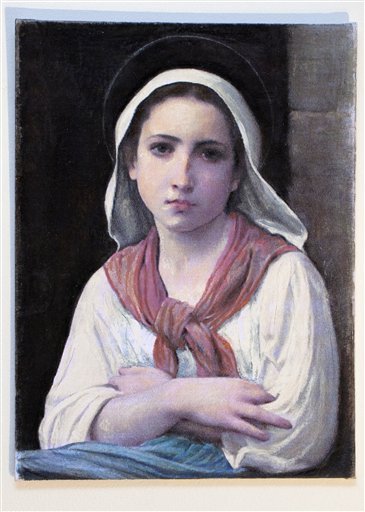 |
| A forged work by Mark Landis |
Lisa Cornwell writing for the AP:
Landis creates works in oil, watercolor, pastels, chalk, ink and pencil, making most of his copies from museum or auction catalogs that provide dimensions and information on the originals. He sometimes bestows gifts under different names, such as the Father Arthur Scott alias used at Hilliard. In that case, he told officials that his dead mother had left works including Curran's oil-on-wood painting "Three Women" and that he was donating it in her memory. . . . The Faux Real show will run through May 20 at the Dorothy W. and C. Lawson Reed Jr. Gallery. It depicts famous art forgers, details of how Landis made some donations and ways of detecting fakes. Visitors can view some works under ultraviolet light that causes sections to glow if they contain contemporary ingredients. Art experts say not accepting payment for his forgeries has helped keep Landis from being charged with a crime. Museum officials say forgeries can hurt their reputation and cost time and money researching suspected fraud.He presents a challenge for prosecutors and the small museums he donates the works to. But the attention paid to him now will hopefully prevent future museums from accepting more forgeries. The exhibition will run through May. ARCA offered advice with respect to the possible ways the law regulates (or to be more accurate has difficulty regulating) these forgeries and donations.
Rabu, 07 Maret 2012
Germany's Master Art Forger
 |
| A forgery of a work by Molzahn |
Beltracchi and three accomplices were sentenced after just nine days at the Cologne District Court, with the defendants receiving shorter sentences in exchange for full confessions. But in a SPIEGEL interview the 61-year-old has now admitted to creating phoney works by "about 50" different artists. Speaking to the media for the first time since he was sentenced, Beltracchi refused to name the exact number of paintings he forged throughout his career, which he began in the 1970s by creating "unpainted works by old masters, and later Jugendstil and Expressionists" and selling them at flea markets. But during the interview with SPIEGEL, Beltracchi said that due to high demand, he could have easily put "1,000 or 2,000" forgeries on the art market.
- Ringleader Reveals He Faked Many More Works, Spiegel Online, March 5, 2012, http://www.spiegel.de/international/germany/0,1518,819409,00.html (last visited Mar 8, 2012).
Jumat, 27 Januari 2012
Footnotes
 |
| "Le Marché" |
- A work by Camille Pissarro, stolen from France in 1981 is on its way back after a United States forfeiture proceeding (previous discussion here).
- Princeton has announced the return of six antiquities with questionable histories to Italy.
- Maya remains and objects were discovered in Belize during a construction project.
- An investment art fraud scheme has been uncovered in Australia.
- Can nuclear physics determine whether a piece of art is genuine?
- Thieves have stolen 2 works of art from an Olympia, Washington art gallery by breaking and entering through a skylight.
- UNESCO has threatened to revoke world heritage status for Seville because of a decision to build a new 40-story building.
Rabu, 08 Juni 2011
Forging Folk Art
 |
| The late Clementine Hunter, at home in Louisiana |
Over the past four decades, Mr. Toye and his wife have been formally accused three times of having sold or trying to sell fakes, most often imitations of paintings by the folk artist Clementine Hunter, whose work Mr. Toye professes to despise. But this is the first time he has been fully prosecuted.
The conspiracy being considered is an odd one, involving Mr. Toye’s British-born wife, Beryl, and a dealer in New Orleans named Robert E. Lucky Jr., who is alleged to have sold the Toye Hunters to customers around the country and in some cases to have resold them after they were returned by disgruntled purchasers.There is a good deal of bad blood. In a floridly reproachful letter in 2005, Ms. Toye told Mr. Lucky that if he were to end up in jail, “it will be with my blessing and my boot up your rear end.” Yet Mr. Lucky and Ms. Toye are scheduled to go on trial in August. (Ms. Toye’s lawyer said she continues to maintain her innocence.)
- Campbell Robertson, “William Toye Pleads Guilty to Fraud,” The New York Times, June 7, 2011, sec. U.S., http://www.nytimes.com/2011/06/08/us/08forgery.html.
- “Baton Rouge man admits Clementine Hunter forgery | NOLA.com”, n.d., http://www.nola.com/crime/index.ssf/2011/06/baton_rouge_man_admits_clement.html.
Kamis, 13 Januari 2011
Wild Story of A Forger who Donates his Forgeries
Randy Kennedy has a super article (following an earlier report in the Art Newspaper) discussing a man named Mark Landis who forges works of art and donates the forgeries to art museums all over America. He may have been doing this for as many as twenty years.
That is a pretty remarkable thing to do, even in the art trade. The lesson is clear though, we can certainly blame the forger/donor, but provenance and the history of an object must be checked, even when an object is donated.
His real name is Mark A. Landis, and he is a lifelong painter and former gallery owner. But when he paid a visit to the Paul and Lulu Hilliard University Art Museum in Lafayette, La., last September, he seemed more like a character sprung from a Southern Gothic novel.
He arrived in a big red Cadillac and introduced himself as Father Arthur Scott. Mark Tullos Jr., the museum’s director, remembers that he was dressed “in black slacks, a black jacket, a black shirt with the clerical collar and he was wearing a Jesuit pin on his lapel.” Partly because he was a man of the cloth and partly because he was bearing a generous gift — a small painting by the American Impressionist Charles Courtney Curran, which he said he wanted to donate in memory of his mother, a Lafayette native — it was difficult not to take him at his word, Mr. Tullos said.
That is a pretty remarkable thing to do, even in the art trade. The lesson is clear though, we can certainly blame the forger/donor, but provenance and the history of an object must be checked, even when an object is donated.
- Randy Kennedy, Elusive Forger, Giving but Never Stealing, N.Y. Times (Jan. 12, 2011).
- Helen Stoilas, "Jesuit priest" donates fraudulent works, The Art Newspaper (Nov. 2010).
Rabu, 25 Agustus 2010
Forgery Ring Discovered in Italy
The BBC and ANSA are reporting that a forged art ring has been discovered by authorities after an 18 month investigation. The investigation was conducted by monitoring payment transfers and consulting art historians. Works recovered include forgeries of works by Matisse and Magritte. There are more than 500 counterfeit works, which may have cost buyers close to 9 million euros.
- Italy seizes counterfeit artwork, BBC, August 25, 2010, http://www.bbc.co.uk/news/world-europe-11088475 (last visited Aug 25, 2010).
Jumat, 18 Juni 2010
"Maybe a Man's Name Doesn't Matter That Much"
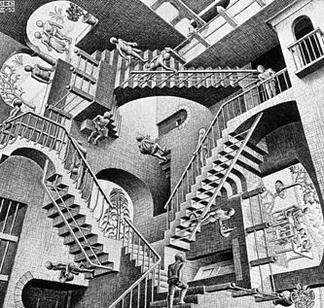
So says Orson Welles in this clip from F for Fake. I couldn't help but think of Welles and his film when reading Martin Gayford's piece on the National Gallery in London's new exhibition "Close Examination: Fakes, Mistakes and Discoveries".

The point of this story is not that art experts are foolish. In fact, the Faun is a very clever forgery. Its brilliance in part is that there actually was a Gauguin sculpture of a faun – it’s listed in an old inventory and may still exist in a cupboard somewhere. The lesson is that now we know it’s not a Gauguin, it ceases to be part of a larger whole: Gauguin’s art. At that point, even if it is still quite an attractive statuette, it loses an enormous amount of meaning. Discovering a work is a fake is like discovering a friend has been lying to you for years.It is difficult to separate the object from the deception. Even if the faun was a terrific work of aesthetic beauty, the fraud which spawned the forgery taints that beauty in our mind—we might even resent the object the better the "fake" really is. That is not to say it cannot be a beautiful object, but it loses something by trying to trick us.
 |
| Relativity, M.C. Escher, 1953 |
The bigger question is how many forgeries are exhibited in museums alongside the authentic works. When buyers and sellers and museums are not careful about the history of an object (including antiquities) we might think of them as a kind of forger as well. They may be unwitting, and fooled by a clever forger as the Art Institute of Chicago was, but when they value the object above everything, they risk becoming complicit in the forgery.
- Martin Gayford, Art forgeries: does it matter if you can't spot an original?, Telegraph.co.uk, June 17, 2010, http://www.telegraph.co.uk/culture/art/art-features/7824999/Art-forgeries-does-it-matter-if-you-cant-spot-an-original.html (last visited Jun 18, 2010).
Selasa, 08 Juni 2010
Vernon Rapley Leaves the Metropolitan Police for the V&A
According to a report by the Art Newspaper, the V&A museum has hired Detective Sergeant Vernon Rapley away from Scotland Yard's art and antiques. The V&A is a massive museum, which has been difficult to safely secure in the past. Here's to hoping he can continue to improve the V&A's security. From the Art Newspaper:
He joins the museum on 21 June, to take charge of security and visitor services. Before turning to art, Rapley investigated murder, paedophilia and child abuse at the Metropolitan Police. He really got to know the V&A in 2004, when there was a spate of thefts at major London museums. The V&A was hit three times, and 38 rooms had to be shut, many for years, while security was upgraded. Supported by the V&A, the Yard set up the London Museum Security Group. Rapley even took a turn as guest curator earlier this year, when he organised a Scotland Yard-curated display at the museum on fakes and forgeries, which spotlighted the case of the Greenhalgh family from Bolton, who created objects ranging from Egyptian antiquities to modern paintings.
- V&A gets its own personal detective | The Art Newspaper, (2010), http://www.theartnewspaper.com/articles/V&A-gets-its-own-personal-detective/21044 (last visited Jun 9, 2010).
Rabu, 27 Januari 2010
Barford on the Sale of Egyptian Antiquities

Barford writes:
Last night in a Luxor sidestreet on my quest for the best or the most bizarre fake artefacts, in a grubby shop I'd overlooked before, I was offered several shabtis and shabti fragments which I am pretty sure were not fakes. All the dealer offered as provenance was "here and there". After I had correctly identified the fakes he'd mixed in to test whether his customer knew his onions, he showed me a lot more. I told him that in his country there was a new law under discussion which would make merely having them in his shop punishable by up to twenty five years. I was not terribly surprised that he would not show me the "authentic scarabs" after that. Those suppliers "here and there" who sold them to him knew that these items were saleable to visiting foreigners.
The day before, I was walking across the palace site at Malkata, showing it to some colleagues, and had just replaced the cardboard "protecting" the wall paintings when a guy in a dark robe came running up. "Closed, closed, zis site he closed" he panted. He was presumably the "gafir" who was guarding this site for the SCA. Once he realised he could not make cash out of showing us the wall paintings which I'd just shown people, he then pulled out of his pocket a blue-painted sherd, the "Armarna ware" which I have seen on the Internet being sold at 300 dollars a piece and asked whether I would like to "see" it. It looked remarkably like the one I'd found there a few weeks earlier and put under a nearby bush to protect it from the sun and weather. I told him where he could put it. Interestingly this was after I had pulled out the photo-identity document issued by the SCA authorising me as an archaeologist to visit sites like this.
. . .
What is interesing about this is Malkata is littered with pottery, tonnes of it. Most of it from the Eighteenth dynasty, including some nice red wares (lovely colours), slipped ware, fine bowls, burnished ware. Yet neither of the would-be vandors had picked any of this up, they knew their market, the blue-painted pottery is coveted by western collectors and that is what they were stealing from the site to make a bit of cash. . . .
 I've had similar experiences at ancient sites as I'm sure many of you have. Pictured here is a man selling small stone 'zapotec' figurines at Monte Alban in Oaxaca Mexico this summer. I don't have the expertise required to tell if these are fakes or not. I've always assumed, as Barford did, that these locals are selling fakes.
Kamis, 03 Desember 2009
César Baldaccini and the Definition of Art

During a trial this week, the brothers will attempt to argue that made these César works as a kind of imitation, but not fakes. In a report by a French magistrate, the "lack of seriousness" of several auction houses was blamed, and the French prosecutor has expressed dismay that the French art market has been "flooded" with these kinds of fakes since the artist's death in 1998.
The investigation into these forgeries began in 2001 by mistake:
Police in the south of France searching for stolen art works, including a Chagall and a Magritte, bugged several suspects in a world of high-living, cocaine-taking art lovers and dealers. They stumbled on evidence that Eric Piedoie was flooding the Côte d'Azur with fake Césars.The appearance of so many unknown works enflamed feelings within César's family and entourage. The artist's wife Rosine Baldaccini and daughter Anna Puységur Baldaccini were disputing his inheritance with his mistress Stéphanie Busuttil. Each side accused the other of selling off works before the dispute was settled in court.Mme Busuttil was allegedly approached by the Piedoie brothers to sign certificates of authentification for some of their works. She says she did so in good faith: a claim accepted by the prosecution.In other words, both César's own mistress and the art critic who catalogued his work could not tell authentic "compression" sculptures from fake ones knocked off in a garage. Awkward questions therefore arise. Were César's "compression sculptures" really art? Are the Piedoie brothers con-artists or true, accidental artists themselves?
- On trial: the question of what is modern art, The Independent, December 1, 2009.
Langganan:
Postingan (Atom)