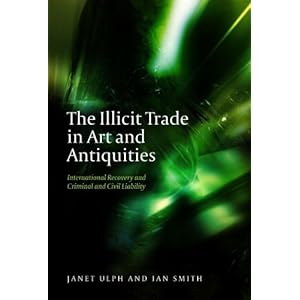
This new text provides practical guidance on the modern law relating to cultural objects which have been stolen, looted or illegally exported. It explains how English criminal law principles, including money laundering measures, apply to those who deal in cultural objects in a domestic or international setting. It discusses the recovery of works of art and antiquities in the English courts where there are competing claims between private individuals, or between individuals and the UK Government or a foreign State. Significantly, this text also provides an exposition of the law where a British law enforcement agency, or a foreign law enforcement agency, is involved in the course of criminal or civil proceedings in an English court. The growth of relevant international instruments, which include not only those devoted to the protection of mankind's cultural heritage but also those concerned with money laundering and serious organised crime, provide a backdrop to this discussion. The UK's ratification of the UNESCO Convention on Means of Prohibiting and Preventing the Illicit Import, Export and Transfer of Ownership of Cultural Property 1970 in 2002 is considered. The problems posed in attempting to curb trafficking in art and antiquities are explored and the effectiveness of the current law is analysed. Janet Ulph is Professor of Commercial Law at the University of Leicester and the main author ofCommercial Fraud: Civil Liability, Human Rights, and Money Laundering (Oxford University Press, 2006).
Ian Smith is a barrister based in London at 11 Stone Buildings, and co-author of Smith, Owen and Bodnar, Asset Recovery: Criminal Confiscation and Civil Recovery (2nd Edition, Oxford University Press, 2007).
Link to table of contentshttp://www.hartpub.co.uk/pdf/9781841139647.pdf
Oct 2012 352pp Hbk 9781841139647RSP:£75 / €97 / US$150 / CDN$150DISCOUNT PRICE FOR BLOG READERS: £60 / €78 / US $120 / CDN $120
http://www.hartpub.co.uk/books/details.asp?isbn= 9781841139647
Order OnlineIf you would like to place an order you can do so through the Hart Publishing website (link above). To receive the discount please mention ref:‘ULPH_SMITHBLOG’ in the special instructions field. Please note that the discount will not be shown on your order but will be applied when your order is processed.
Tampilkan postingan dengan label Scholarship - Books. Tampilkan semua postingan
Tampilkan postingan dengan label Scholarship - Books. Tampilkan semua postingan
Senin, 22 Oktober 2012
New Book on the Illicit Trade in Art and Antiquities
I've been forwarded information on what looks to be an excellent new work by Janet Ulph and Ian Smith, The Illicit Trade in Art and Antiquities: International Recovery and Criminal and Civil Liability, published by Hart. The publisher has kindly offered readers of this blog a discount. Here are the details:

Rabu, 08 Agustus 2012
New Book on Illicit Trade
Asif Efrat has a very interesting new work titled: Governing Guns, Preventing Plunder: International Cooperation against Illicit Trade (Oxford University Press). In an email Asif summarized the work:

The book's main empirical chapter examines the efforts against the illicit trade in antiquities. This chapter explains why the United States and Britain initially resisted UNESCO's efforts for the protection of the cultural heritage, and why both countries ultimately reversed course (several decades apart) and joined the 1970 UNESCO Convention. I analyze the domestic political debates over antiquities in the United States and in Britain, examining the views and arguments of the main contenders in these debates: archaeologists, museums, and dealers. The analysis highlights important similarities in the American and British experience as well as notable differences, such as the different positions taken by the museum communities in the two countries and the divergent responses of the American and British bureaucracies to the problem of illicit trade.
Looks to be a very good examination with the benefit of empirical data. It is a longer follow-up to an earlier work, which I mentioned here a few years ago.

Senin, 07 Mei 2012
An Interview with Nout van Woudenberg on Immunity

Immunizing this art from a potential suit has been an important step lenders have asked states to provide them. But this immunity is not without critics. I caught up with Nout van Woudenberg and asked him a little bit about his new book, 'State Immunity and Cultural Objects on Loan'. He is an external researcher at the University of Amsterdam and Legal Counsel at the International Law Division of the Ministry of Foreign Affairs of the Kingdom of the Netherlands.
Setting down to write, what was your aim with ‘State Immunity and Cultural Objects on Loan’?
Some years ago, it occurred to me that it was not clear whether States actually knew what the current state of affairs was with regard to immunity from seizure of cultural objects belonging to foreign States while on loan abroad. In 2004 the convention on jurisdictional immunities of States and their property had been established under auspices of the United Nations, addressing, among other things, immunity for cultural State property on loan. But that convention has not yet entered into force. I thus considered it necessary to investigate whether another rule of international law was already applicable: a rule of customary international law. After all, that rule would be binding upon States, without necessarily becoming a party to a convention.
And so I did: I investigated whether a rule of customary international law exists, to the effect that cultural objects belonging to foreign States are immune from seizure while on loan to another State for a temporary exhibition. And if such a rule does not yet exist, is it emerging? And if such a rule does exist, what are its limitations? It is my aim that my study, and consequently this book, can provide more clarity and legal certainty in the field of lending and borrowing cultural State property. But there is more: the book describes the national legislation of States, reflects opinions of States, lists what kind of guarantees States are likely to give, provides academic views, and so on. I thus hope not only to bring clarity in the field of international law, but also hope that this book is considered to have a certain encyclopedic value in regard to relevant State practice.
When did nations first start asking for immunity for their art? How have the reasons for granting this immunity changed, if at all?
It is my impression that the very first request came from the former Soviet Union in the middle of the 1960s. The catalyst was an imminent exchange between a Soviet museum and the University of Richmond, US, in which the latter sought to import several cultural objects that had been expropriated by the Soviet Government from art collectors. The Soviet Union asked for a grant of immunity from seizure, as protection against former Soviet citizens claiming title to the cultural objects, a condition of the loan. As a result of the immunity from seizure request, the United States was the first country to introduce immunity from seizure legislation in 1965.
Since then, the issue of immunity from seizure for travelling cultural objects has become more and more a concern for States and museums. This is mainly due to an increasing number of legal disputes over the ownership of cultural objects, particularly as a result of claims made by heirs to those objects expropriated by Communist regimes in Eastern Europe as well as Holocaust-related claims. But there may be disputes other than ownership disputes which result in attempts to seize a cultural object, and that phenomenon is more recent: for instance when an individual or a company is of the opinion that the owner of the cultural object on loan owes a debt (not necessarily related to the cultural object) to the claimant, and this claimant has concerns regarding the enforcement of a judgment or arbitration award in the State of residence of the owner. An example is the 2005 Noga case in Switzerland, where the company Noga asserted that it was a creditor of the Russian Federation, and the 2011 Diag Human case in Austria, where the company Diag Human argued that it was a creditor of the Czech Republic. One last remark in regard to your question: one might wonder whether we need to speak about granting immunity. After all, in the Swiss Noga case, and the Austrian Diag Human case, the Swiss federal authorities and the Viennese court respectively, have ordered that on the basis of customary international law, the cultural State property on loan was immune from seizure. Many other States are of this opinion as well, as I show in my book. They sometimes count on the general rule of customary international law that State property in use or intended for use for government non-commercial purposes is immune from measures of constraint, but a considerable number of States also count on the existence of a specific rule of international law immunizing cultural State property on loan. If this line is to be followed, there is no situation of granting immunity (actively doing something), but the immunity from seizure merely applies.
The cover of your book uses Portrait of Wally a painting which was granted immunity in New York State court but was eventually seized in Federal Court by US Attorneys. What is your reaction to the result in that case?
First of all, I would like to thank the Leopold Museum in Vienna to allow me to use this image for the cover of my book. Now in regard to the case: the fact that the case lasted approximately twelve years, in combination with the fact that the case and the judgment went back and forth several times, gives sufficient indication for stating that it regarded a complex and not very clear-cut case. Although it regarded a painting seemingly forcibly sold by Lea Bondi at the beginning of WW II, the US court case focused very much on the question of what Dr. Leopold knew or ought to know when he acquired the painting in 1954. In the end, it came to an amicable settlement, and that should be applauded and respected. We now may be able to say that both the Museum and the Bondi Estate are “winners” as they came to terms with each other. However, the fact that the case lasted that long, and that the outcome went back and forth repeatedly, is not very helpful in promoting the certainty which is necessary in the field of international art loans. Also the Museum as well as the Bondi Estate had to go through a lot during these years of litigation.
What are your thoughts on immunity generally? Is it a useful tool to allow for the movement of art?
Absolutely. But let me limit myself to immunity for cultural State property on loan. Basically, the reason for providing cultural objects with immunity from seizure is to prevent cultural objects on loan from being used as ‘hostages’ in trade and/or ownership disputes. Immunity from seizure can serve as a means to overcome the reluctance of lenders to send their cultural objects temporarily abroad. We also have to keep in mind that many States have committed themselves through international legal instruments to supporting the exchange of cultural objects. It can be said that nowadays there is a well-established and universally shared interest to protect and enhance the international cooperation of museums and other cultural institutions. Moreover, in the literature, links have been made between cultural objects and diplomatic relations: international art loans can symbolize and foster these diplomatic relations.
Cultural objects can break the ice of misunderstandings and can be the first steps in new bilateral ties. They are sometimes referred to as ‘good will ambassadors’. Immunity from seizure facilitates inter-State art loans. That background may serve as a proper explanation why immunity from seizure for cultural State property on loan is understandable. In relation to this, I would also like to refer to the UN Convention on Jurisdictional Immunities of States and Their Property. On 2 December 2004, the UN General Assembly adopted the convention by consensus. It has not entered into force yet, but a considerable number of States consider the convention as a reflection of customary international law. Part IV of the 2004 UN Convention regards State immunity from seizure. It provides in general, but subject to certain limitations, for the immunity of a State from all forms of seizure in respect of its property or property in its possession or control. This part of the convention also contains an article where State property is listed which shall not be considered as commercial property. Consequently, this property is immune from seizure (unless the State to which the property belongs has explicitly consented to seizure or has allocated the property for the satisfaction of the connected claim). The relevant article, Article 21, aims to secure the protection for certain specific categories of property. One of the five categories of property reads “property forming part of an exhibition of objects of scientific, cultural or historical interest and not placed or intended to be placed on sale.” State-owned exhibits for industrial or commercial purposes are not covered by this category. It should be borne in mind that the gist of Article 21, and especially the cultural category, has neither been disputed during the negotiations. In my view, the fact that cultural objects can be important for the identity of a State, the fact that cultural objects may help to understand the culture, history and development of a State, as well as the fact that cultural objects can be used as a means in the promotion of international cultural exchanges (codified in several international agreements) and the strengthening of bilateral or multilateral diplomatic relations, makes it fair to consider these cultural objects on loan as a category of protected State property. Consequently, I do not consider it awkward to mention cultural State property on loan in one breath with one of those ‘classical’ categories of protected objects, such as military property, diplomatic property or property of the central bank of a State (and that is exactly what the 2004 UN Convention did).
What are the biggest problems you have found with respect to immunized art? Are there reforms you can suggest?
In regard to immunity from seizure for cultural State property on loan, important questions are: “what is a State?” and “what is to be considered as State property?” Answering these questions is not always easy. Different national and international legal instruments each follow their own approach in regard to the definition of a State. It can also depend on the acts performed by an agency or instrumentality of a State whether or not it falls under the definition of a State (or whether or not it enjoys the same immunity as the State). In practice, this can mean that it is up to national courts to consider whether in an actual situation an organ or entity can be identified as falling under the definition of a State. In most jurisdictions, a State museum will not fall under the definition of a State. However, that does not mean that the cultural objects housed in that State museum are subject to seizure by definition. Immunized State property would be broader than solely property that is owned by a State. Under the aforementioned 2004 UN Convention, property owned by the State and property in its possession or control would most likely be covered by the immunity provisions, although the exact scope has not yet been determined in practice. Although there is no specific definition of State property in the 2004 UN Convention, I come to this conclusion based on the history of negotiations and the reports of the International Law Commission. Generally speaking, based on my investigation, it would be fair to say that in any case property that is State-owned or of which the State serves as a custodian or has a right of disposal would fall under the immunity. And here we come to the second part of your question: the fact that immunity from seizure does not only apply to cultural objects on loan owned by a State, but also to objects possessed or controlled by a State, can make the application of the rule in practice somewhat complicated; it may be necessary to determine on a case by case basis whether a cultural institution should be considered as falling under the notion of a State (which will mostly not be the case), and whether in the actual situation it is the State which either owns, possesses or controls the objects concerned. As a result, it may be possible that loans between lending and borrowing institutions have to be considered differently, with regard to possible immunity. After all, a cultural institution can house objects which are owned by a State, a State may be able to exercise control over other objects, and some objects may not have a link with the State at all. A future global convention on immunity from seizure for all kinds of cultural property on loan, regardless whether it regards State property or private property, may solve such a situation. The International Law Association is currently assessing whether such a convention may possibly be viable, however, the assessment is still in its embryonic stage (the underlying discussion paper has been prepared by Prof. Th. M. de Boer and me). A convention like that may provide more legal security, but also raises new questions such as a possible overlap or discrepancy with the 2004 UN Convention.
Many in the United States are hesitant to offer an opinion on immunity, particularly with respect to a proposed clarification to current U.S. practice moving through the U.S. Congress. I think this may be because immunity has increasingly been conflated with preventing justice. Do you think immunity prevents claimants from achieving a just result for their claim to a work of art?
It occurred to me that several pending cases before a US court regard cultural property which is not on loan in the US, but is, and has been, in the ‘State of origin’. To name a few cases of past and present: the Altmann case, the Cassirer case, the Herzog case and the Popper case. Here we are not talking about immunity from seizure, but immunity from jurisdiction. And also in the Malewicz case, plaintiffs did not try to seize the cultural objects which were on loan to two US museums.
The question what a ‘just result’ may be, will be answered differently by different people. But I have to sympathize with a Statement of Interest of the US in the Malewicz case. The heirs were there, in the view of the US authorities, “using the window of opportunity afforded by the Malewicz exhibition[s] as the jurisdictional hook for their claims”.
The Executive Branch stated: “if jurisdiction over a sovereign lender could be established solely by virtue of introduction into the United States of an exhibit immunized under section 2459, foreign States would be far less likely to agree to share their artwork with the American public, undermining the principal objective of section 2459” and “a finding of no jurisdiction in this case would merely prevent claimants from transforming into a sword what was intended to be only a shield.” From the perspective of international art loans, I have to admit that, in general, I have difficulties to agree with the idea that the presence of the objects (for the purpose of exhibition) in the jurisdiction of the borrowing State might provide a jurisdictional hook enabling the court in the borrowing State to exercise jurisdiction over the acts of a lending State. Even more, as domestic remedies often have not been exhausted.
In regard to immunity from seizure, I have to recall that on February 3rd, 2012, the International Court of Justice was not at all hesitant to offer an opinion on immunity; it confirmed in the case Germany v. Italy that State property with a government non-commercial purpose, is immune from immunity from seizure unless the State which owns the property has expressly consented to the taking of the seizure or that that State has allocated the property in question for the satisfaction of a judicial claim.
Finally with regard to the current US draft legislation, which aims to make the relationship between the FSIA and the IFSA clearer: I do think that the content of this legislation confirms the main conclusions of my study: I come to the conclusion that indeed a relatively young rule of customary international law exists, although not yet firmly established or well defined in all its aspects, stating that cultural objects belonging to foreign States and on temporary loan for an exhibition are immune from seizure. However, an important remark needs to be made in that regard: in order to be considered as a rule of customary law, a rule needs to be based, among other things, on a widespread, representative and virtually uniform practice of States (as well as opinio juris). With regard to some categories of cultural State property, this wide, virtually uniform acceptance is absent. The most important category regards cultural objects plundered during armed conflict. Based on my study, I would say that, generally speaking, the main sentiment among States is that such objects should not deserve protection. Although not legally but certainly morally binding, many States subscribed to the 1998 Washington Principles on Holocaust Era Assets, the 2000 Vilnius Declaration on Holocaust Era Looted Cultural Assets and the 2009 Terezin Declaration on Holocaust Era Assets and Related Issues. Moreover, several States established Restitution or Spoliation Committees in order to restitute cultural objects to heirs of World War II victims. Also the draft legislation which is currently under assessment of the US Senate confirms the immunity for cultural property on loan, unless it regards cultural property illicitly taken during the Holocaust.
Minggu, 21 Agustus 2011
An Art Theft Anniversary
100 years ago Vincenzo Peruggia stole this painting:
And 50 years ago Kempton Bunton stole this painting:
Noah Charney discusses both in an Op-Ed for the LA Times:
To read more about the Mona Lisa thefts, you can read Noah Charney's long essay, The Thefts of the Mona Lisa: On Stealing the World's Most Famous Painting , available from Amazon. All of the proceeds support ARCA. You can also read my short forward to the book, where I argue that perhaps we'd all be better off had the work stayed stolen.
 |
| The Mona Lisa |
And 50 years ago Kempton Bunton stole this painting:
 |
| Goya's The Duke of Wellington |
Noah Charney discusses both in an Op-Ed for the LA Times:
These two famous art thefts, the date of the latter chosen by the colorful Bunton for the theatricality of falling on the anniversary of the former, helped to mold the public perception of art theft as a crime of oddball characters who did not really harm anyone. It is true that some of the many famous art thefts of the period preceding World War II were of this ilk, involving quirky nonviolent thieves with gentlemanly aspirations.
To read more about the Mona Lisa thefts, you can read Noah Charney's long essay, The Thefts of the Mona Lisa: On Stealing the World's Most Famous Painting
, available from Amazon. All of the proceeds support ARCA. You can also read my short forward to the book, where I argue that perhaps we'd all be better off had the work stayed stolen.Rabu, 25 Mei 2011
Chasing Aphrodite Reviewed

Jason Felch &
Ralph Frammolino
Disputes over works of art and antiquities take many forms. Nations and individuals with claims to cultural objects pursue their claims in a number of areas; only seldom are these battles seen in courts of law. As a consequence many of the precedents set for party’s actions are seen outside the public view. This underscores the terrific resource which Jason Felch and Ralph Frammolino have created with their new book, officially released yesterday.
Their terrific series of investigative reports for the Los Angeles Times served as the jumping off point for the work. That series of articles was a finalist for the 2006 Pulitzer Prize and helped me crystallize much of my thinking about the antiquities trade and the role of art museums. Those reports, though terrific, were limited by the length of a newspaper article, and the authors continued their reporting in the form of this work to allow the space to explore these issues. In so doing they have created what will stand as the definitive account of the troubled times at the Getty from its creation in the 1970s through 2007. The book takes the form of a straightforward and rigorous account of the events which led to first the creation of the wealthiest art-acquiring institution in the world, its unfortunate choices, and its painful public shaming.
The authors maintain their reporters tone, which serves the material well. I think partisans on both sides of the heritage debates will find much to admire in the consistent and accurate depiction of characters and events. One point for which the authors deserve high marks is their description of the laws at issue—they swiftly and accurately describe the complex network of U.S., Italian and International laws without letting it overwhelm the story they are telling. There are also references and notes for further readings. The book maintains a lively and direct style throughout. I was provided an electronic copy of the work, which had no page numbers, so I am unable to reference the quotations below.
The sources for the book are impressive. They include the personal records of Arthur Houghton, who emerges as an early attempted reformer, Getty records, private correspondence, court records in Rome, and interviews with over three-hundred key individuals. The authors note the only important figures they were not able to interview were J. Paul Getty; Jiri Frel, the first antiquities curator at the Getty, who emerges as an early villain; and Marion True, a complicated figure who because of her unwise acquisitions at the Getty all while championing reform leave me feeling more baffled as to her motivations than ever.
 |
| From Left: Barbara Whitney, Deborah Gribbon, John Walsh and Marion True in happier days |
One really does wonder at times with the benefit of hindsight what True was thinking. She earned the contempt of her colleagues in the Museum community for aggressively implementing stringent acquisition standards at the Getty and criticizing the acquisitions by other museums, all while directly purchasing objects which were surely looted. The authors really do well in juxtaposing her actions at the Getty with her public rhetoric about the antiquities trade. Their description of her testimony at a 1999 Cultural Property Advisory Committee meeting evaluating an Italian request for import restrictions into the United States really highlights the hypocrisy:
. . . True strongly defended the Italian request. She deemed “improper” the suggestions of some that it was better to have illicit antiquities on well-tended American shelves than to let the careless Italians keep them in dusty exhibits. American museums were just as careless with their objects, True said. Many still didn’t have updated inventories or pictures of their own items . . . True noted that Italy was becoming more generous with loans of ancient art. Policies that expected Italy to be able to document objects that had been looted, like the one the Getty used to rely on, were irretrievably flawed.
Such comments surely did not endear True to her colleagues. In fact, the Getty had violated many legal and ethical rules to acquire their objects, and once they had a renowned collection had declared, under True’s direction, that the rules of the trade had changed, and other institutions must follow the Getty’s lead. This may perhaps explain why the Getty helped support True by paying her legal fees in her criminal trial in Rome, but had distanced itself publicly.
 |
| The "Getty Bronze", one of the few disputed objects which has not been returned |
Those early days set the Getty on what seems to have been a course which could not have avoided trouble. Particulary in chapter four, titled “Worth the Price”. Perhaps because he seems to have offered a great deal of assistance to the authors, Arthur Houghton emerges as an important early figure who attempted to check some of Jiri Frel’s unethical and illegal conduct, particularly in . Early on Houghton recommended that the Getty adopt what he called “optical due diligence” which meant “[t]he Getty should create the appearance that the objects it was acquiring had been carefully vetted, but at the same time avoid ‘certain knowledge’ of where they were actually coming from.” This concept of optical due diligence will likely strike a familiar chord with many observers, but a phrase which I have not seen expressed with such simplicity before.
As the authors note, Houghton was far more concerned with tax fraud that Frel was committing on a grand scale. He would routinely accept donations from wealthy donors, vastly increasing the appraised value of the objects. As the authors note the optical due diligence “was a surprisingly cynical position for Houghton to take, given his moral outrage at Frel’s transgressions. But in his mind, tax fraud and forgery were entirely different from breaking the export laws of a neglectful foreign country, especially when the goal was to educate and enlighten Americans.” In fact, Houghton’s actions were probably consistent with the vast majority of American curators at the time. And given the culture in the early 1980’s, Houghton was probably right that the Getty would likely earn a lot of trouble for itself fast if the IRS discovered the endemic tax fraud.
 |
| Aphrodite (or Persephone) has been returned to Aidone |
Though the Getty now boasts an impressive legacy of research and vast works of art, the early days of the institution are less-than-stellar. One wonders if J. Paul Getty was really the dour, humorless penny-pincher he is depicted to be. The Getty originated not as part of some grand passion for the arts but as a passing hobby of a fantastically rich oil man. As such, those early founders of the Getty trust emerge as important trend-setters who would struggle initially with vast sums of money, and a desire to create one of the world’s foremost cultural institutions. That they succeeded is a testament to the vast wealth they were provided, and also the passion that these objects instill. But the question we must ask is at what cost?
A major theme I see emerging from the book are the incentives which helped fuel this looting. More attention has been directed at recently-acquired objects certainly, but Marion True was an early star in her field because she created galleries and exhibitions of objects with skill in such a way that made the public take notice. The public likes to look at these beautiful objects, and advocates need to continue to do the hard work to essentially train them to be ‘context connoisseurs’, meaning just because an object is beautiful, does nto mean that it should belong in a museum. The path these objects take matters. Had the Getty played by the rules, and not acquired many of these dubious objects, would it have emerged as such an important cultural institution? I’m not sure it would have. We see many poor choices by Marion True in the work, but she also emerges as one of a number of individuals at the Getty, yet she is the only one to have been shamed in such a public way and put on trial. In a perfect world many more probably should have taken blame for these acquisitions.
And the reason for that likely lies in the special esteem that the looted objects instill in us. The Italian government wanted to do everything it could to secure the return of these objects while also ensuring that future illicit activity would not take place, but to secure those returns took many years of hard investigation, and time-consuming and expensive legal negotiation. The Italian team which worked to pressure the Getty and other institutions into returning objects—Maurizio Fiorilli, Paolo Ferri, Francesco Rutelli and others—all emerge as sympathetic figures. Yet they would have had grave difficulty securing the returns had they employed a more direct strategy of prosecution of individuals at the Getty. Their efforts to focus charges on Robert Hecht, Giacomo Medici and Marion True appear to have been an effort to pressure the Getty into returning objects.
The work focuses on the Getty and Marion True and the direct line which can be drawn to looters in Italy. The limestone Aphrodite (which may in fact be Persephone) serves as an apt metaphor for the antiquities trade as a whole. When you heap such esteem on objects, without respecting its past, you risk distorting the object into something it never was. The limestone statue and its marble head, with its stunning depiction of billowing fabric was likely looted from Morgantina in Sicily. The authors introduce the objects at issue well I think, describing their composition, what we know of their history, and also noting what has been destroyed by looters. One feels outrage at the way this statue, perhaps the finest example of classical Greek sculpture outside of London or Greece was smuggled to Switzerland in a carot truck:
Some had seen the body of the statue—without the head—in three pieces at the house of a looter in Gela . . . The huge statue had been toppled over onto a blunt object, breaking it cleanly into three pieces that would be easier to hide during transport. The clean breaks also would make the statue easier to reassemble. The pieces were then driven to Milan, buried under a load of carrots in the back of a Fiat truck, and transported north across the border to Chiasso [Switzerland].
Many will likely point to the illegal and unethical conduct of the Getty in the work, and they are right to do so. Yet the archaeological community and nations of origin have much to answer for as well. When these ancient cities are studied, concern needs to be directed at the source to how the locals will react. What good is a trained archaeologist who painstakingly unearths parts of an ancient city, only to have her work undone at night by looters. That really is the legacy of the dispute between Italy and the Getty which the authors skillfully detail. Moving forward how can we envision a collaborative network which follows the law, but also protects sites, allows for professional excavation, and allows us to steward these precious resources for future generations.
Jumat, 29 April 2011
Miller on the Doctrine of Discovery
The Doctrine of Discovery was an international legal principle which allowed European settlers to claim any lands they 'discovered' from the indigenous peoples living there.This attitude, which seems shocking today, lies behind much of the call for restitution of objects and cultural heritage today. Robert J. Miller (Lewis & Clark Law School) has posted "Christianity, American Indians, and the Doctrine of Discovery."
(via)
The European countries that explored and colonized North America utilized the international law Doctrine of Discovery to claim the sovereign, property, and human rights of Indigenous peoples. Discovery was developed primarily in the fifteenth century by Spain, Portugal, England, and the Church and was designed to control the acquisition of non-European lands. The assumed superiority of European religions and civilizations played a major role in justifying Discovery. Starting with the fifteenth century papal bulls and the later English Royal charters, the primary goals of colonization were alleged to be "propagating Christian Religion" and bringing "human civility" to the "pagan," "heathen," "Infidels and Savages" who "yet live[d] in Darkness and miserable ignorance of the true Knowledge and Worship of God." The United States Supreme Court expressly adopted the Doctrine of Discovery in 1823 in Johnson v. M'Intosh and expressly relied on Christian religion and Euro-American civilization to justify its decision. The goals of, and the justifications for, Discovery continued to be part of United States Indian policy and Manifest Destiny until nearly the end of the twentieth century.
(via)
Senin, 10 Januari 2011
Weber on Liability for Faked or Wrongly Attributed Works of Art in the U.S.
Marc Weber, an attorney in Zurich, has passed along his recent book section on certain aspects of U.S. law dealing with fake or wrongly attributed art works. It appears in a volume honoring Kurt Siehr on his 75th birthday, which appears to be worth seeking out as well, with contributions in both English and German. Marc has made the piece available at his website, and I've reproduced the introduction below:
A work of art isn’t always what it seems to be. Sometimes the buyer learns that he has just purchased a forgery and sometimes the seller realizes that he has just sold an original. As with other contract dispute, the dissatisfied party will seek redress in the courts, but the courts are faced with problems that are specific to dispute arising from the sale of art when it comes to fakes, the provenance and authenticity of works of art.
If the sold piece of art is a forgery, the buyer sues for the repayment of the purchase price in exchange for the return of the work of art. The buyer will seek to do the same after having bought a work of art which is not executed by the artist but by his school. The seller attempts to sue the buyer for the return of the work of art in exchange for the restitution of the purchase price, should a work of art sold as a real copy turn out to be the work of the master or a painting from a school is actually a work of the master himself. The legal remedies of the first case (warranty) differ from the ones of the second case (mistake).
In addition to the remedy of rescission of the contract, under certain circumstances, a cause of action for product disparagement may arise. Finally, if artists’ authentication boards or committees are considered as the only authority to authenticate certain pieces of art, breaches of antitrust laws could be claimed.It is a concise and very lively summary of the relevant legal rules, with helpful summaries of many of the major cases. It is also a suitable tribute to Prof. Siehr, who I have not had the pleasure of meeting, but who has some outstanding scholarly writings which are well-written, scholarly, and sometimes even funny.
Rabu, 06 Oktober 2010
Stealing the Mystic Lamb Review
 I've just finished reading Noah Charney's "Stealing the Mystic Lamb: The True Story of the World's Most Coveted Masterpiece". This review should probably begin with a disclosure. Noah is a friend and colleague, first an internet acquaintance, and now we meet up every summer in Amelia during ARCA's MA certificate program which he founded.
 This work tells the story of one massive 2-ton altar piece, the single most stolen work of art of all time, and one that should be familiar to anyone who has taken an introduction to art history course.
After dropping the reader into history as allied forces are searching for the altar piece during World War II, we learn early on that this work was the prize of Hitler and Napoleon. That this massive masterpiece was nearly destroyed many times over. Yet somehow it has endured.
And we should all be glad it has. The object itself is stunning, Charney in the first chapter takes the reader through the importance of the painting itself, how it helped launch the career of Jan van Eyck, how art historians have puzzled over how much of the work was completed by van Eyck's brother Hubert, how the artist used intricate symbolism, how it helped usher in the era of oil painting and beautiful detail. But perhaps most importantly, the discussion of this painting and all it symbolizes reminded me why art matters, and how a stunning work of art can change the way we all see the world, and each viewer gets a chance to re-learn or even re-evaluate those shifts in opinion. And in the end the work begins with a lively account for why individuals have stolen, mutilated, and coveted this work of art.
Next the reader learns about the artist himself, about the "Magician in the Red Turban". the reader also learns about attribution, the recent decline of connoisseurship in the appreciation of art, how the movement of art can cause the re-appraisal of works of art as happened when the Albert Barnes Collection is preparing to move and many of its Old Master paintings were found to have been misattributed. We learn about the creation of the Louvre, the place the Ghent altarpiece played in the creation of that museum, and how many of the arguments made for a universal museum were made by Dominique Vivant Denon who served as the architect of the art looting during Napleon's reign.
Charney spends great care telling the story of the altarpiece during both World Wars, noting the debt we art theft writers owe to Karl Meyer, Robert Edsel and Brett Witter's fine work telling the story of the Monuments Men, and Lynn Nicholas among many others. Yet what really comes through in Charney's book is a breathless story which merges history, towering figures like Napoleon or Hitler and their associates, art, artists, and imagery that revalidates why so many are interested in the study of art theft: these are really good stories. And it ends with an epilogue, yet another of the work's enduring mysteries, that should not be spoiled here.
Kamis, 02 September 2010
Craig Childs on Archaeology
Craig Childs talks to NPR about his new book "Finders Keepers":
Audio after the jump
Author Craig Childs' new book, Finders Keepers: A Tale of Archaeological Plunder and Obsession, reads almost like a thriller, chock-full of vendettas, suicides and large-scale criminal enterprises dedicated to the multimillion-dollar trade in antiquities.
Childs tells NPR's Audie Cornish that emotions run high in the world of antiquities. "There's such an attachment to what is the right and wrong thing to do with these objects," he says. "What is legal? What is illegal? It really rises to the surface to where I know some archaeologists who want pot hunters dead, and I know pot hunters who want archaeologists dead." His book follows several families of pot hunters who ran afoul of the government after digging up relics on public land.
And many objects now in museums may not be legal, Childs says. For example, the famous Euphronios krater, an ancient Greek vessel for mixing wine and water, stood in the Metropolitan Museum of Art for almost 40 years. "You'd go into the Met and there it was, in its own display case," Childs says. "Just beautiful paintings of warriors and gods all around it, one of the finest Greek vessels ever found, and it was sold with paperwork that said, you know, this thing is legal." But an extensive investigation proved that the krater had been looted from an Etruscan tomb in Italy, and in 2008 the Met returned it to the Italian government.
Audio after the jump
Senin, 12 April 2010
Public Comment on the U.S.-Italy Memorandum of Understanding
The State Department Cultural Heritage Center has announced it wants public comments on the potential renewal of the Memorandum of Understanding (MOU) between the United States and Italy.
There is also an opportunity to write a letter and express your opinion on the MOU, the deadline is April 22, 2010. The Archaeological Institute of America has information on the letter-writing process here. Note that you should either fax (202-632-6300) or email (culprop@state.gov) your letter due to security delays with traditional mail.
This is one of the ways in which the United States has chosen to implement the 1970 UNESCO Convention. The MOU does a number of things. It restricts the import of certain classes of undocumented objects from Italy. But if those objects carry the appropriate documentation, importation is allowed. It also calls for long-term loans of Italian objects, and collaboration between the United States and Italy.
Those interested in the MOU and the practical impact it has or has not had should look to the recent edited volume, Criminology and Archaeology (Simon Mackenzie and Penny Green, 2009). I review the volume in the Spring issue of the Journal of Art Crime. Of particular interest is Gordon Lobay's contribution, which looks empirically at how the U.S.-Italy MOU has made an impact on the antiquities market—at least the observable licit market. I encourage interested readers to check out the volume, as his conclusion has been that the volume of objects sold, and their prices have increased over time. The most profound impact has been that auction houses have begun to "pay more attention to provenance." Though typically this is not the findspot or complete history but rather reference to an earlier sale of an object.
There will be a meeting of the Cultural Property Advisory Committee on Thursday, May 6, 2010, from 9 a.m. to approximately 5 p.m., and on Friday, May 7, 2010, from 9:00 a.m. to approximately 3 p.m., at the Department of State, Annex 5, 2200 C Street, NW., Washington, DC. During its meeting the Committee will review a proposal to extend the``Memorandum of Understanding Between the Government of the United States of America and the Government of the Republic of Italy Concerning the Imposition of Import Restrictions on Categories of Archaeological Material Representing the Pre-Classical, Classical and Imperial Roman Periods of Italy'' signed in Washington, DC on January19, 2001 and amended and extended in 2006 through an exchange of diplomatic notes.
This is one of the ways in which the United States has chosen to implement the 1970 UNESCO Convention. The MOU does a number of things. It restricts the import of certain classes of undocumented objects from Italy. But if those objects carry the appropriate documentation, importation is allowed. It also calls for long-term loans of Italian objects, and collaboration between the United States and Italy.
Those interested in the MOU and the practical impact it has or has not had should look to the recent edited volume, Criminology and Archaeology (Simon Mackenzie and Penny Green, 2009). I review the volume in the Spring issue of the Journal of Art Crime. Of particular interest is Gordon Lobay's contribution, which looks empirically at how the U.S.-Italy MOU has made an impact on the antiquities market—at least the observable licit market. I encourage interested readers to check out the volume, as his conclusion has been that the volume of objects sold, and their prices have increased over time. The most profound impact has been that auction houses have begun to "pay more attention to provenance." Though typically this is not the findspot or complete history but rather reference to an earlier sale of an object.
Langganan:
Postingan (Atom)