Tampilkan postingan dengan label Cambodia. Tampilkan semua postingan

Jumat, 17 Mei 2013

Cambodia Presses Other Museums

Tom Mashberg reports that Cambodia now has requested objects from others, including:
  • Denver Art Museum
  • Cleveland Museum of Art
  • The Norton Simon,
  • And of course Sotheby's which is challenging a federal forfeiture
New York's Metropolitan Museum announced it would return two other statues. It seems to have encouraged the Cambodians and their advocates to look for other similar material. And that precedent set by the Met may compel these other institutions to return objects. From the NYT piece:


The Met’s two statues represent brothers of Bhima who knelt in attendance during the fight. The Met’s statues were acquired in four pieces from donors 1987 to 1992. Those statues, plus the one from Sotheby’s, are known to have gone through a London art dealer, Spink & Son, in the early 1970s. Cambodian officials say the broken pedestals of all those sculptures were left in the ground by the looters. Norton Simon, who died in 1993, bought the Bhima in 1976 from a Madison Avenue Asian art dealer and gave it to the museum in 1980. “In more than three decades, the foundation’s ownership of the sculpture has never been questioned,” the museum said in a statement. The Sotheby’s statue was shipped to New York in 2010 to be sold at auction by its Belgian owner, Decia Ruspoli di Poggio Suasa. Her husband, who has since died, acquired it in 1975 and Sotheby’s estimated its value to be $2 million to $3 million. Experts on antiquities trafficking say teams of bandits used ox carts to trundle their trophies along jungle trails and into Thailand, 15 miles north, during Cambodia’s war years. In their case against Sotheby’s, lawyers for the United States attorney’s office for the Southern District of New York say the statue was one of many shipped illicitly from Bangkok to the United States and Europe after 1970. Sotheby’s says the statue was legally purchased in good faith from a reputable London auction house in 1975 and it “denies knowledge that the Duryodhana statue was stolen.” Cambodia’s secretary of state, Chan Tani, said the looting of Koh Ker is especially crushing because its style of statuary exists nowhere else. “They are part of our soul as a nation,” he said, “and they were brutally stolen.”

 One aspect I find really intriguing is how Cambodia has seemingly eschewed the Italian approach of offering long term loans and continuing to have a relationship with these institutions. Not sure why that may be, I'd be interested in hearing some ideas below in the comments.

Mashberg, Tom. “Cambodia Presses U.S. Museums to Return Antiquities.” The New York Times, May 15, 2013, sec. Arts / Art & Design. 

Jumat, 03 Mei 2013

The Met Announces the Return of two statues to Cambodia

Today, Ralph Blumenthal reports that the Met has agreed to return two 10th century statues to Cambodia. The Met's director Thomas Campbell is quoted as saying:

This is a case in which additional information regarding the 'Kneeling Attendants' has led the museum to consider facts that were not known at the time of the acquisition and to take the action we are announcing today.

 The piece reports the statues may have been removed from Cambodia at around the same time the Koh Ker statue was removed, which is the subject of an ongoing forfeiture action by a federal prosecutor. Little information has been reported that I can find on the precise circumstances surrounding the removal of these statues from Cambodia. We know the instabality and conflict taking place in southeast Asia at the time of course. The statues were donated by Douglas Latchford in a series beginning in 1987. The parts of the statues were broken into pieces at some point, and the individual pieces of the figures were donated between 1987-1992. Conservators at the Met reattached the heads and bodies in 1993.

The Met should be congratulated for doing the right thing here with these objects which have such an important connection to Cambodia. This return may also give pause to Sotheby's, the Norton Simon museum, and others who have objects which were removed from Cambodia during this period.


Blumenthal, Ralph. “The Met to Return Statues to Cambodia.” The New York Times, May 3, 2013, sec. Arts / Art & Design. http://www.nytimes.com/2013/05/04/arts/design/the-met-to-return-statues-to-cambodia.html.

Senin, 04 Maret 2013

Increasing the Use of Forfeiture in Policing Heritage

The NYT's Tom Mashberg reports that Sharon Cohen Levin and Alexander Wilson (two Assistant U.S. Attorney's) have traveled to Cambodia to examine the site where the 10th Century Koh Ker statue was likely looted in Cambodia. I have no way of knowing whether a trip like this is unusual or not. It seems to me to be a good idea to get some context for the original looting. For those who don't know, Assistant U.S. attorneys are the Federal government's prosecutors. And when these folks take on a case, they do so selectively, and generally only if they are confident in a win. These offices across the country have a very high winning percentage in the cases they take on. So it is not much of a surprise that these AUSA's have decided to make a trip to Cambodia to examine the site itself:

The NYT image of the feet at the temple
where the Koh Ker statue was likely looted
A Cambodian government spokesman, Ek Tha, said the delegation that visited the temple included Cambodian and foreign archaeologists. A federal judge is scheduled to rule in weeks on whether the government’s case to seize the statue can proceed to trial. In earlier arguments District Judge George B. Daniels has pressed prosecutors on what proof they had that the statue, called the Duryodhana, was taken in the 1970s. Sotheby’s has been trying to sell the statue, valued at as much as $3 million, on behalf of its Belgian owner since 2011. The United States government says the auction house had reason to suspect that the statue had been stolen, and that it is the rightful property of Cambodia, citing laws governing antiquities adopted when the country was a colony of France. Sotheby’s has said the statue was legally purchased in good faith from a reputable London auction house in 1975 by the owner’s husband, now deceased, who had no reason to suspect that such a sale could be bound by laws set by a government that had long passed from power. In a statement the auction house said the trip by the lawyers “will not change critical weaknesses in the government’s case — most importantly, its reliance on hopelessly ambiguous French colonial decrees.”

Those French decrees aren't all that ambiguous when considered in light of these two feet without the rest of the statue.

I thought the comments of Rick St. Hilaire were interesting, he argued that this trip was a kind of show of force by the AUSA's. Not sure if that is true or not, or even if these folks even need to be concerned with a  show of force, but it does highlight I think how even remote areas like this temple complex are more closely connected than before, and that makes a forfeiture proceeding like this more likely to proceed.


  1. Tom Mashberg, United States Officials Travel to Cambodia in Statue Case, The New York Times, March 1, 2013, http://www.nytimes.com/2013/03/02/arts/design/united-states-officials-travel-to-cambodia-in-statue-case.html (last visited Mar 4, 2013).


Rabu, 14 November 2012

Prosecutors Allege Customs Violations in Koh Ker Statue Forfeiture

Prosecutors have amended their complaint which seeks to forfeit this Koh Ker Khmer statue. Much of the press coverage focuses on whether the colonial French government or some other legal enactment created ownership rights in the statue before the time it was removed.  I don't have a pacer account and access to these court filings, but based on the reporting it appears prosecutors saw a difficult path to victory in attempting to apply colonial French law to the statue. Instead they are also seeking a more straightforward argument: arguing that the importers of the statue lied on their customs forms. From the NYT:

Prosecutors say that in 2010, when the statue was being imported into the United States, the owner submitted an inaccurate affidavit to American customs officials, at Sotheby’s request, stating the statue was “not cultural property” belonging to a religious site. The government contended in its filing on Friday that both parties knew the statue, a mythic Hindu warrior known as Duryodhanna, valued at up to $3 million, was stolen when they agreed to ship it from Belgium to New York. The government says it can prove that the statue in fact came from a Khmer Dynasty temple, Prasat Chen, part of a vast and ancient complex called Koh Ker.

If prosecutors can establish these statements were inaccurate, the more difficult question of which law might apply to the statue would be largely irrelevant. This is the same legal principle used when prosecutors successfully forfeited a 4th-century B.C. ancient golden phiale from Michael Steinhardt in 1999. Lying to customs officials is a violation of the law, with its own forfeiture provision. If the prosecutors can establish this, a successful forfeiture seems very likely.


  1. Tom Mashberg & Ralph Blumenthal, Sotheby’s Accused of Deceit in Sale of Khmer Statue, The New York Times, November 13, 2012, http://www.nytimes.com/2012/11/14/arts/design/sothebys-accused-of-deceit-in-sale-of-khmer-statue.html (last visited Nov 14, 2012).
  2. United States v. An Antique Platter of Gold, 184 F. 3d 131 (2nd Cir. 1999).

Rabu, 24 Oktober 2012

An Update on the Koh Ker Statue and Sotheby's

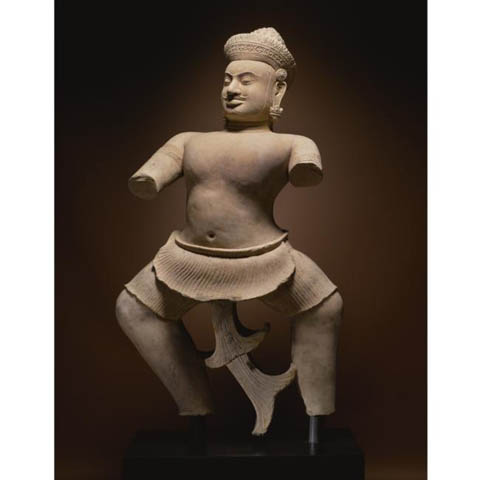
The United States and Cambodia are locked in a legal battle with the auction house Sotheby's over this 1,000-year-old statue of the Hindu warrior Duryodhana that may have been looted from the Cambodian temple complex at Koh Ker.
Anthony Kuhn reports for All Things Considered on the ongoing dispute between Cambodia and Sotheby's over this Koh Ker statue. The feet were found at the complex, but Sotheby's is attempting to prevent any seizure of the statue. This looting likely took place in the late 1960's. The Cambodians make a compelling case for the statue, while Sotheby's refused to comment for the piece. I'll update the case here as it develops.


Jumat, 29 Juni 2012

The Fourth Annual ARCA Conference

We have just returned from Amelia and the first five weeks of the ARCA program in Amelia. Last weekend ARCA held its fourth annual conference, and the event gets better every year, a fact evidenced I think by how many folks returned to Amelia for the conference again this year. The event brings together a diverse set of talents, which is necessary given the challenges facing heritage advocates. These dangers include theft, archaeological looting, the sale of illicit objects in the market, forgery, and destruction during armed conflict. And the challenge of course when one begins a conference is to ask what one little conversation can do in the face of this heritage crime. Our hope is to take the conversation and carry it back to our work. As we know, many of these conversations focus on the Mediterranean, and the return of illicit objects there (and even the claims for more returns).


This means of course that many other areas of the World are left under-considered. To open the conference I discussed the ongoing case of a looted statue from Koh Ker which has been seized by U.S. attorneys in a forfeiture proceeding from Sotheby's. We were able to invite with His Royal Highness Ravivaddhana Sisowath, Prince of Cambodia to give some remarks. He spoke about the importance of these statues to the people of Cambodia, and the circumstances surrounding their removal in the conflict during the 1970s involving the Vietnam War and the Khmer Rouge. Later on Saturday we were able to present awards in person to three of the very best kinds of advocates in this field: Joris Kila, an expert in protecting cultural heritage during armed conflict who has visited Libya and other at risk sites; Jason Felch, a reporter for the L.A. Times who has continued important work in this field with ideas like Wikiloot; and finally George Abungu, the Vice-President of ICOM and a powerful advocate for heritage protection. His discussion of African rock art was one of the very best discussions of art and heritage protection I have seen.


There were many other highlights—the presentation from Dr. Laurie Rush on heritage protection as a force multiplier was outstanding, and of course the early career presentations were some of the best of the weekend. 


Many many thanks to everyone at ARCA for such a terrific weekend, including Monica, Lynda, Catherine, Kirsten, Noah, and of course Joni. You can save the date already for our fifth conference, June 22-23, 2013 in Amelia again.  

Senin, 04 Juni 2012

Cambodia considers repatriation of two more statues

One of two kneeling statues
from Koh Ker, at the Met

Cambodia has discovered it may have a claim to another set of objects in New York. But these statues are on display at the Met, not up for auction. 

The contested statues may have been taken from the same temple where a mythic warrior figure (discussed earlier here) was likely looted in the early 1970s. It seems the Cambodians have uncovered other objects which they may have tenable claims for in the wake of the research into the statue from the Koh Ker complex which was removed from auction at Sotheby's last month. Federal prosecutors have initiated a forfeiture proceeding against that statue, based on the fact that despite the armed conflict at the time, Cambodia's earlier pre-existing legal principles had established the statue was owned in some way—and thus any removal would have been an illicit removal. 

It seems research into the temple complex and the established law have allowed Cambodia to cast a wider net for their repatriation claim. It will be interesting to see how the Met responds to Cambodia's questions. The initial reaction from the Met in the piece does not seem to show the Met asked for much history when these objects were acquired:

 The museum acknowledged that beyond the names of the donors it has no records on the statues’ origins, despite a longstanding policy to investigate the history of donated antiquities. “No one is concealing anything,” said Harold Holzer, the Met’s senior vice president for external affairs. “I’d like nothing better that to find more documentation.” Mr. Holzer cautioned against using current standards for museum collecting to evaluate the propriety of acquisitions dating back more than two decades. “There were no real prevailing restrictions against accepting these works of art,” he said of the period, “especially if, by doing so, they might be protected from disappearance completely from public view and from study.” The Met’s policy in 1992 allowed it to accept works without a detailed provenance. Such acceptance, though, was supposed to come after an effort had been made to root out the history of a piece in case it was illicit.  

  1. Tom Mashberg & Ralph Blumenthal, Cambodia to Ask Met to Return 10th-Century Statues, The New York Times, June 1, 2012.

Rabu, 04 April 2012

Report that Federal Agents will seize Khmer Statue from Sotheby's

It looks like the attention drawn to Sotheby's auction of this Koh Ker statue will result in Federal seizure of the statue:

Federal agents in New York on Wednesday moved to seize a thousand-year-old Cambodian statue from Sotheby’s, alleging in a civil complaint that Sotheby’s had put the 10th-century figure of a mythological warrior up for auction despite knowing that it had been stolen from a temple. Investigators said the sandstone statue, whose return is being sought by Cambodia and which is valued at $2 million to $3 million, would be impounded on Thursday by agents from the United States Department of Homeland Security. The statue, consigned to Sotheby’s for sale by a Belgian collector, had been set for auction in New York in March 2011 but was abruptly pulled from the market at the last minute after Cambodia claimed ownership. At the time Sotheby’s rejected Cambodia’s efforts to recover the Khmer antiquity, insisting there was no proof that it had been looted and therefore the auction was legal. But in a series of internal e-mail exchanges obtained by investigators and included in the federal complaint filed Wednesday in United States District Court in New York, at least one Sotheby’s officer is depicted as having been told in 2010 by a scholar in Cambodian art that Cambodian officials considered the statue a looted artifact.
With evidence that Sotheby's was told the statue had been looted, the Federal agents have a powerful piece of evidence they did not have in the Ka Nefer Nefer case. I would expect the unnamed Belgian collector who put the statue up for consignment to consider relinquishing the statue quickly. If it was purchased in good faith, he or she has a good claim against the dealer they bought it from. How long new before the Norton Simon is pressured to return its version of the statue?

  1. Ralph Blumenthal & Tom Mashberg, Ancient Cambodian Statue Is Seized From Sotheby’s, The New York Times, April 4, 2012, http://www.nytimes.com/2012/04/05/arts/design/ancient-cambodian-statue-is-seized-from-sothebys.html (last visited Apr 4, 2012).

Selasa, 28 Februari 2012

Cambodia Disputing a Koh Ker statue up for auction at Sotheby's


The disputed limestone Koh Ker statue
Cambodia is asking for assistance from the U.S. government in repatriating a limestone statue which was likely looted during the Vietnam War/Khmer Rouge era. Jane Levine, compliance director for Sotheby's argues that "there are widely divergent views on how to resolve conflicts involving cultural heritage objects". Here is mine.

The statue has considerable value, its pre-sale auction price was estimated at between $2-3 million. That estimate will likely be considerably less after the report in the New York times, detailing the dubious history of the object. Sotheby's claims the object was acquired by a "noble European lady" in 1975. Hardly a complete history of the object, and hardly enough to invoke the protections of good faith. The absence of information should not confer the benefits of a good faith purchase. Sotheby's argues the burden should be placed on Cambodia. I wonder though if the blunt reality of two feet without a body might lead a thinking person to a different conclusion. No museum can ethically acquire this object. Though the Norton Simon has a similar statue, also without feet, no word yet on whether Cambodia may seek the repatriation of that statue as well.

I would expect if a resolution between Sotheby's and Cambodia cannot be reached that the government consider using its forfeiture powers on the grounds the statue was under the ownership of Cambodia after a 1925 French colonial law declaring objects in Cambodia to be the exclusive property of the state.

Should the forfeiture proceeding be declined, I would urge Cambodia or its lawyers to consider using a civil action using as a precedent the English case, Bumper Development Corp. v Commissioner of Police for the Metropolis [1991] 1 WLR 1362. That case successfully achieved the repatriation of an object taken from an Indian temple, but it was the temple itself was given legal rights as a party. Perhaps there is a legal personality in Cambodia which might offer a similar connection to this statue.
    A Pedestal in Cambodia, which might be the base
  1. Tom Mashberg & Ralph Blumenthal, Sotheby’s Caught in Dispute Over Prized Cambodian Statue, The New York Times, February 28, 2012, http://www.nytimes.com/2012/02/29/arts/design/sothebys-caught-in-dispute-over-prized-cambodian-statue.html (last visited Feb 28, 2012).

Senin, 21 Juni 2010

US Returns Angkorian Sculptures to Cambodia

 The United States returned seven sculptures today which had been smuggled out of Cambodia.  The statues were recovered in Los Angeles in 2008.  They objects include two heads of Buddha, a bas-relief, and also an engraved plinth.  I'm unable to find any details about the seizure at present, but these returns may be tied to the investigation of Galleries and Museums in California in early 2008. 
  1. AFP: US returns stolen Angkorian sculptures to Cambodia, AFP (2010), http://www.google.com/hostednews/afp/article/ALeqM5goRoNfmLD0vbnGwi6ospmF1MBRmQ (last visited Jun 17, 2010).
  2. The Associated Press: US returns 7 stolen ancient Cambodian sculptures, AP (2010), http://www.google.com/hostednews/ap/article/ALeqM5iDRqLsyg_5D0Sim77b6ZhkroOlXAD9GCTS800 (last visited Jun 17, 2010).