Tampilkan postingan dengan label seizure. Tampilkan semua postingan

Senin, 04 Maret 2013

Increasing the Use of Forfeiture in Policing Heritage

The NYT's Tom Mashberg reports that Sharon Cohen Levin and Alexander Wilson (two Assistant U.S. Attorney's) have traveled to Cambodia to examine the site where the 10th Century Koh Ker statue was likely looted in Cambodia. I have no way of knowing whether a trip like this is unusual or not. It seems to me to be a good idea to get some context for the original looting. For those who don't know, Assistant U.S. attorneys are the Federal government's prosecutors. And when these folks take on a case, they do so selectively, and generally only if they are confident in a win. These offices across the country have a very high winning percentage in the cases they take on. So it is not much of a surprise that these AUSA's have decided to make a trip to Cambodia to examine the site itself:

The NYT image of the feet at the temple
where the Koh Ker statue was likely looted
A Cambodian government spokesman, Ek Tha, said the delegation that visited the temple included Cambodian and foreign archaeologists. A federal judge is scheduled to rule in weeks on whether the government’s case to seize the statue can proceed to trial. In earlier arguments District Judge George B. Daniels has pressed prosecutors on what proof they had that the statue, called the Duryodhana, was taken in the 1970s. Sotheby’s has been trying to sell the statue, valued at as much as $3 million, on behalf of its Belgian owner since 2011. The United States government says the auction house had reason to suspect that the statue had been stolen, and that it is the rightful property of Cambodia, citing laws governing antiquities adopted when the country was a colony of France. Sotheby’s has said the statue was legally purchased in good faith from a reputable London auction house in 1975 by the owner’s husband, now deceased, who had no reason to suspect that such a sale could be bound by laws set by a government that had long passed from power. In a statement the auction house said the trip by the lawyers “will not change critical weaknesses in the government’s case — most importantly, its reliance on hopelessly ambiguous French colonial decrees.”

Those French decrees aren't all that ambiguous when considered in light of these two feet without the rest of the statue.

I thought the comments of Rick St. Hilaire were interesting, he argued that this trip was a kind of show of force by the AUSA's. Not sure if that is true or not, or even if these folks even need to be concerned with a  show of force, but it does highlight I think how even remote areas like this temple complex are more closely connected than before, and that makes a forfeiture proceeding like this more likely to proceed.


  1. Tom Mashberg, United States Officials Travel to Cambodia in Statue Case, The New York Times, March 1, 2013, http://www.nytimes.com/2013/03/02/arts/design/united-states-officials-travel-to-cambodia-in-statue-case.html (last visited Mar 4, 2013).


Jumat, 26 Oktober 2012

U.S. Repatriates 4,000 Looted Antiquities to Mexico

Yesterday U.S. law enforcement officials returned 4,000 object to Mexico. They are the fruit of 11 different investigations in cities like El Paso, San Antonio, Fort Stockton, Phoenix, San Diego, Chicago and Montana. These kinds of 'art on the table' news conferences are quite common. But I admit to feeling conflicted about them. On the one hand they certainly speak to the degree of seriousness with which ICE agents and the Federal Government take these crimes. But as with any crime that becomes federalized like this, the incentives are I think primarily geared towards rewarding these big investigations and successful returns. Yet the underlying problems endemic to the antiquities trade itself are not treated or targeted. It is an important step, but also the more of these returns I see (and there are a lot of them) the more frustrating it becomes as well. Because these investigations target the objects. There is no mention of arrests, prosecutions or of much of anything which would produced sustained compliance on the part of the art trade.

In fact after reading the news release I feel more pessimistic about the mass of objects which are being smuggled up from the south. Consider that three statues were smuggled in by a migrant worker on a bus; another clay statue was hidden in luggage in El Paso; another statue was hidden in the dash of a vehicle; a grinding stone was found in another vehicle; another millstone was found in the back of a truck; and the list goes on. These are straightforward and low-cost means to smuggle the objects into the country. We cannot I think expect ICE agents to catch every smuggled object found in luggage, trucks or cars. The trade itself and art buyers need to step up at some point and correct a market which routinely accepts these looted and stolen objects. But that kind of sober reflection on these recoveries is not to be found in the statements of U.S. and Mexican officials. From the ICE news release:

"The plundering of cultural property is one of the oldest forms of organized cross-border crime and has become a worldwide phenomenon that transcends frontiers," said HSI Assistant Director Janice Ayala. "The teamwork and cooperation that exists between ICE's Homeland Security Investigations and our Mexican law enforcement counterparts, as well as with U.S. federal, local and state law enforcement agencies made it possible for us to secure these cultural artifacts and to ensure that they are returned to the government of Mexico. HSI will remain committed to combating the looting and trafficking of Mexico's cultural treasures."
Consul General of Mexico Jacob Prado stated, "The restitution to Mexico of more than 4,000 archaeological pieces, which were seized by ICE's Homeland Security Investigations special agents, is proof of the excellent collaboration that exists between Mexico and the United States, and attests to the relevance of the institutions and legal framework that our authorities have developed to successfully address the many different issues of our bilateral agenda." Consul General Prado also expressed the gratitude of the government and the people of Mexico to the six HSI offices involved in recovering the artifacts, "for their support to ensure the restitution of these archaeological pieces, which are part of the cultural heritage and the historical memory of the people of Mexico."

Sabtu, 05 Mei 2012

Italian Court Confirms Seizure of "Getty Bronze"

The Getty received some very bad news Thursday.

Jason Felch reports on a ruling by an Italian regional magistrate in Pesaro upholding an earlier ruling to seize the bronze statue.

The ruling Thursday by a regional magistrate in Pesaro will likely prolong the legal battle over the statue, a signature piece of the Getty's embattled antiquities collection whose return Italian authorities have sought for years. "This was the news we were waiting for," said Gian Mario Spacca, president of the Marche region where the statue was hauled ashore in 1964, in an interview with Italian reporters. "Now we will resume contacts made with the Getty Museum to build a positive working relationship." Spacca visited the Getty last year hoping to negotiate an agreement to share the statue. But the Getty has made clear it will fight in court to keep the piece and is expected to appeal the ruling to Italy's highest court.

Using a domestic court to seek the seizure of an illegally exported object from another country has not been attempted before. But Italy has been at the forefront of repatriation strategies. This novel approach could lead to a new legal tool for nations of origin to pursue, if it can convince the Attorney General and a U.S. District Court to enforce this seizure order. The Getty appealed the earlier ruling, and they did so for a reason, this case could set a precedent which would open up museums to seizure suits in the nation of origin.

It should be interesting to watch this dispute continue. For background on this dispute, see here.
  1. Jason Felch, Italian court upholds claim on Getty bronze, L.A. Times, May 4, 2012, http://www.latimes.com/entertainment/arts/culture/la-et-getty-bronze-ruling-20120504,0,2759444.story (last visited May 5, 2012).

Rabu, 09 November 2011

France Seizes Painting Stolen in 1818

Christ Carrying the Cross, Nicolas Tournier
The owner of Weiss Gallery in London is in "complete shock" after officials from the French ministry of culture have refused to allow The Carrying of the Cross, by Nicolas Tournier to be taken from France back to England. The gallery purchased the painting at a Maastricht art fair last year for 400,000 Euros. The gallery took it to a small old master art fair in Paris called Paris Tableau, but France has now detained the work of art.

Mark Weiss, the owner of the gallery stated "I've been in communication with the director of the Toulouse museum since I acquired the painting in 2010, and at no stage has he ever stated that the picture was a stolen painting." The work originally hung in a chapel in Toulouse, but during the French Revolution the work was confiscated and moved to a museum. It was then apparently stolen from a museum in 1818. It would be interesting to know more about what those conversations were like between Weiss and the Toulouse museum.

France has argued this is the rediscovery of a long-lost work, yet it was stolen nearly two centuries ago. Have there been persistent claims for its return? I'm not sure. It is difficult to envision the French have the legal right to seize the painting so long after its theft. They do have the de facto power perhaps to temporarily detain the work, and make life very difficult for the gallery owner. Any experts in the area of French law care to offer any opinions? The newspaper accounts have merely focused on the seizure, without diving into the merits.
  1. AFP: British gallery rejects France’s claim to painting, (2011) (last visited Nov 9, 2011).

Selasa, 18 Januari 2011

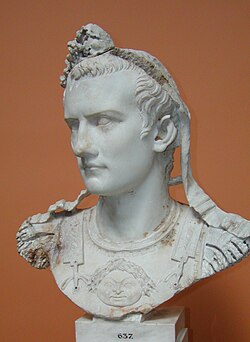
Looted Statute (maybe Caligula) Seized Near Rome

A Bust of Caligula at the Ny Carlsberg Glyptotek
Italian police have arrested a tombarolo with an 8-foot ancient statue not far from Rome. The statue may be worth €1 million. They believe the statue may be of Caligula, and may even have been looted from Caligula's tomb, which has not been discovered. We surely won't know if this tomb or the site was the actual tomb, but if looting is destroying the archaeological record, we are losing information.

Might the record have given us information on Caligula, who may have received a bad rap from the sources which have survived antiquity? Contemporaries describe the emperor as insane, saying he appointed a horse as consul, slept with his sisters, and killed often. But these might have been claims made by his political enemies in the senate and elsewhere—perhaps not too different from today's politics. After all, how could the son of Germanicus (my favorite Roman) have been such a bad guy. Caligula only ruled from AD 37-41, before he was assassinated.

I wonder where this statue was going to be sold? The United States, the middle-East, Asia? Excavations will start to reveal the archaeology of the site where the tomb raider unearthed the massive statue.

  1. Tom Kington, Caligula's tomb found after police arrest man trying to smuggle statue, The Guardian, January 17, 2011, http://www.guardian.co.uk/world/2011/jan/17/caligula-tomb-found-police-statue (last visited Jan 18, 2011).

Kamis, 15 April 2010

Italian Seizures, the Bronze Athelete, and the Getty

The Getty has decided to appeal the February decision in which an Italian court ordered the seizure of this statue, Bronze Statue of a Victorious Youth.  An Italian appeals court judged ordered the work returned to Italy.  This was a new legal approach as nations as far as I'm aware have not attempted to bring forfeiture proceedings domestically, with an expectation that a foreign government or court would uphold the order.  Perhaps the Italian courts could seize other assets the Getty has in Italy in lieu of recovery, but my initial conclusions are shared by Patty Gerstenblith in Martha Lufkin's excellent summary of the current disposition of the dispute.  Gerstenblith notes two problems.  First, illegal export does not give Italy a tenable claim in U.S. courts.  It may in conjunction with a law like the Cultural Property Implementation Act and bilateral agreements, but those were all enacted after the bronze was brought to California.  Second, an awful lot of time has elapsed, and it is likely that an American court will take a dim view of the length of time Italy has taken before this action.  Indeed, charges were brought in Italy against the fisherman who brought the bronze up in their nets in the 1960's, but the defendants were acquitted. 

There is an extralegal dimension to the appeal as well, in that Italy continues to put pressure on the Getty, and its means of acquisition of the statue. 

We may question the Getty's acquisition of the bronze, question where it currently belongs, and even debate the merits of restitution of these objects.  However, there is no evidence that this bronze was "looted" in the same way the Euphronios Krater was for example.  All reports I'm aware of indicate the fishermen fortuitously brought this up in the Adriatic, in international waters, in 1964.  They may have later passed it on to others who smuggled it out of the country, but this is not a looted object.

For noteworthy previous posts on the bronze, see here.


  1. Martha Lufkin, Greek bronze will stay in the Getty Villa, The Art Newspaper, April 14, 2010.

Selasa, 05 Januari 2010

Portable Antiquities Seized in Iraq


Iraqi police announced today the seizure of 39 antiquities discovered hidden near a shrine outside Nasiriyah in Southern Iraq.  These included clay tablets and statues, some of which may date from the 4,000 year-old Sumerian civilization. Are these objects from one of Iraq's museums?  Were these objects looted from nearby archaeological sites?  If I could speculate on why the objects were hidden near a shrine: it may have been a convenient place to hide these looted objects for sale to visitors to the shrine. 

  1. Katherine Houreld, Iraqi police seize artifacts amid smuggling fears - Washington Times, Associated Press, January 5, 2009.

Kamis, 08 Oktober 2009

Free Wally!

 The 10-year battle over the rights to this work may soon be nearing the beginning of the end:


A federal judge in Manhattan ruled that the U.S. government and the Leopold Museum in Vienna have enough evidence to possibly lay claim to the "Portrait of Wally."  The painting by Austrian expressionist Schiele in 1912 depicts his mistress and primary model.    The U.S. government confiscated the painting when it was on loan from the Leopold, claiming the museum knew the painting had been stolen by a Nazi in 1939 from its Jewish owner, Lea Bondi.   The Leopold sent more than 100 works by Schiele to New York's Museum of Modern Art in 1997.  Acting on information that two paintings had been looted in Austria during World War II, Manhattan District Attorney Robert Morgenthau seized "Portrait of Wally" and "Dead City" from the museum.


And the work has been in storage ever since.


Jonathan Perlow, Dispute Over Schiele Painting Heads to Trial [Courthouse News Service, Oct. 7, 2009]