Last week a number of folks drew my attention to the news that in Greece two men have been sentenced to life in prison for dealing in antiquities. The objects they looted and handled were worth an estimated €12 million. Two more men were jailed for 20 and 16 years. Based on the very brief AP report, it seems the men were digging near Thessaloniki close to an ancient cemetery.
I have seen a few remark that these very stiff sentences should be applauded and even are a sign that the Greek government takes archaeological looting seriously. I don't know the specifics of this case, and it is not clear if these four sentences will be appealed and what kinds of parole options the violators will have. So we are dealing with a number of unknowns. And as a result I'd like to make a humble plea for a little sobriety when sentences of this nature are handed down. Too many archaeologists and other advocates hop up and down and either rejoice at these strong sentences—or criticize probation and fines which are at the other end of this spectrum. I think having a vigorous debate about what role prosecutions, and custodial sentences may play in reducing looting is a welcome development, but one should not make the mistake of jumping into sentencing policy without at least some cursory introduction very complicated field.
The deterrent power of criminal sanctions is very much an open question about even the 'big' crimes the justice system is supposed to prevent, things like murder and armed robbery. In the United States and in many other nations the criminal justice system is an imperfect mechanism which too often is asked to accomplish things it cannot. To expect this flawed institution to come riding in and solve the problems of heritage management, looting, and theft is terribly unrealistic. As many have pointed out, there is no magic bullet for heritage crime. Police and prosecutors have a role to play, but the stakeholders need to step up as well. Nations of origin, auction houses, buyers, and museums should not expect a flawed institution to fix what they are unable or unwilling to fix themselves.
Tampilkan postingan dengan label Greece. Tampilkan semua postingan
Tampilkan postingan dengan label Greece. Tampilkan semua postingan
Kamis, 27 Desember 2012

Senin, 26 November 2012
Olympia Antiquities Recovered
 |
| Some of the recovered objects from Olympia |
Given such a high-profile theft, in an olympic year, it is safe to assume that Greek authorities made recovering these stolen objects a high priority. A task which at the time was seemingly more difficult as there was speculation that these small, portable objects would have been easily shipped abroad or smuggled across the Adriatic to organized criminal networks in the Balkans. But it seems the objects did not make it far away from Olympia.
On Sunday authorities in Greece announced three Greek men were arrested in the city of Patra after an undercover officer posing as a potential buyer was offered one of the highlights of the theft, a Bronze Age gold ring. The remaining objects were found in a field near Olympia, where they had been buried inside a sack. So congratulations are in order for Greek law enforcement. And given the context of the theft, it is noteworthy that the Greek Public Order MInister Nikos Dendias told reporters on Sunday that "Despite the difficult economic situation we are not being lax on security issues, especially over our cultural heritage."
Here is some video of the press conference and the recovered objects from Al Jazeera:
- Greek police recover stolen Olympia artefacts, , http://www.aljazeera.com/news/europe/2012/11/2012112582211277291.html (last visited Nov 26, 2012).
- Greek police recover stolen Olympia artefacts, arrest three, Reuters, November 24, 2012, http://www.reuters.com/article/2012/11/24/us-greece-olympia-idUSBRE8AN08H20121124 (last visited Nov 26, 2012).
Senin, 18 Juni 2012
Two Antiquities Smugglers Arrested in Greece
Earlier in June two men were arrested for allegedly smuggling an ancient gold wreath and armband out of the country:
The suspects were stopped by highway police near the village of Asprovalta, some 40 kilometers (25 miles) east of Thessaloniki late Thursday. Officers, who were working on a tip that the house painter might be trafficking in antiquities, found the 4th century B.C. artifacts in a shoebox under the passenger seat. The wreath was a rare and valuable find, said Nikos Dimitriadis, head of the Thessaloniki police antiquities theft section. “It is a product of an illegal excavation from a Macedonian grave, according to archaeologists (who examined it),” he said.
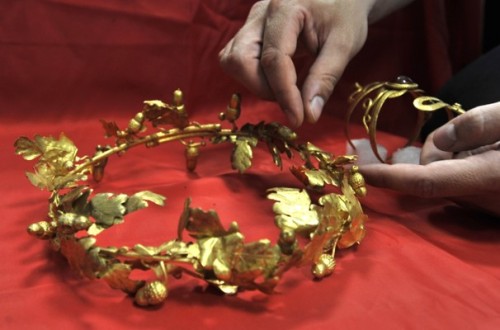
- Associated Press, 2 arrested in Greece for alleged antiquities smuggling of ancient gold wreath, armband, The Washington Post, June 8, 2012, http://www.washingtonpost.com/world/europe/2-arrested-in-greece-for-alleged-antiquities-smuggling-of-ancient-gold-wreath-armband/2012/06/08/gJQAijagNV_story.html.
Senin, 11 Juni 2012
Kennedy reports in NYT on austerity and Greek sites
 |
| The Olympia museum in Greece, site of an armed theft |
The ad, produced by the Association of Greek Archaeologists, is most immediately a reminder of an armed robbery of dozens of artifacts from a museum in Olympia in February, amid persistent security shortcomings at museums across the country. But the campaign’s central message — “Monuments have no voice. They must have yours” — is a much broader attack on deep cultural budget cuts being made as part of the austerity measures imposed on Greece by the European economic establishment, measures that have led in recent weeks to an electoral crisis, a caretaker government and the specter of Greece’s departure from the euro zone. Effects of the cultural cuts are already being felt by the public, as museum galleries and sometimes whole museums suffer from sporadic closings.
Despite the persistent claims that austerity played a role in that Olympia Museum theft, there has been no evidence of this, other than the circumstantial connection between Greek austerity and budget cuts and the armed theft early in the morning itself. We may be critical of the Greeks—but in times of economic hardship difficult choices must be made. And Greece is certainly not the only nation making those choices. Consider the Met's recent decision to quietly deaccession some old masters, the Getty's recent funding cutbacks, or even the Corcoran's potential sale of its building in Washington D.C. Difficult choices for all of these cultural institutions have to be made.
Kennedy's piece does a fine job relating the perspectives of the Greek archaeologists affected. But is austerity a cause of the looting and theft? Or rather is it the thieves and looters who commit these crimes, and austerity provides them with a slightly more vulnerable target.
We should perhaps remember that other arts reporters for the New York Times have a habit of travelling to the mediterranean and pointing out flaws in the cultural resource management of the Greeks and Italians. Consider this piece from Michael Kimmelman in 2009 criticizing the Italians and the Villa Giulia after the repatriation of the Euphronios Krater.
- Randy Kennedy, Archaeologists Say Greek Antiquities Threatened by Austerity, The New York Times, June 11, 2012, http://www.nytimes.com/2012/06/12/arts/design/archaeologists-say-greek-antiquities-threatened-by-austerity.html (last visited Jun 12, 2012).
Minggu, 18 Maret 2012
ARTHattack! Interview
Vanja Stojanovic, a terrific student at the University of Guelph put together this short interview after the ARTHattack! conference where I talk a bit about ARCA, the current situation in Greece and the art market:
Senin, 20 Februari 2012
More on Antiquities Thefts

Both instances are troubling examples of thieves overcoming museum security. But, to borrow a phrase from Prof. Merryman, no thinking person would use these thefts to argue that (1) Western museums should repatriate all their antiquities; or (2) Greece should sell its "surplus" antiquities to alleviate its culture funding difficulty. Both propositions are wrongheaded. They are a reason why cultural heritage policy has such difficulty getting off the ground, if the discourse can't even acknowledge and admonish thieves as thieves.
With respect to the Olympia thefts, there is not much to report since last Friday's theft. Channel 4 has a short video report showing the interior of the museum and images of the kinds of objects which were stolen. Dick Ellis, who formed the Art and Antiques Squad (and also lectures in ARCA's Summer Program in Amelia) is quoted in the piece. He notes that
It has become an organised crime business the incentive is there to make money in Greece. . . . And they may well begin a life which sees them travel from the poorer hands of the lowly thieves who broke into the museum to reach the lucrative shores of London or New York, and in some cases, find themselves auctioned off for tens of millions of dollars. . . . I am sure the current economic situation is Greece is triggering people to become more active, . . . I would expect these objects are going to get moved. It's a transitional country for other stolen goods, and they can go west or east.
The Channel 4 Video:
- Armed robbers loot ancient Greek museum - Channel 4 News, (2012), http://www.channel4.com/news/armed-robbers-loot-ancient-greek-museum (last visited Feb 20, 2012).
Jumat, 17 Februari 2012
Armed Antiquities Theft from the Greek Museum in Olympia
 |
| The Museum in Olympia, before the theft |
This theft comes after the theft from the National Gallery in Athens, and amid protests and fires which have destroyed some buildings. It also has caused the Greek Culture Minister Pavlos Geroulanos to resign. Connections will be drawn to Greek austerity, but whether it was funding cutbacks which have made this theft possible has not been established. There was a breakdown of security here, and it may be that thieves saw the thefts in Athens and were brazened. A culture ministry official told the AP that the thieves "seem to have operated more as if they were carrying out a holdup".
Yiannis Mavrikopoulos, head of the culture ministry museum and site guards' union put the cutbacks squarely at the feet of the bodies urging Greek cutbacks: "The cutbacks imposed by the European Union and the International Monetary Fund have hurt our cultural heritage, which is also the world's heritage . . . There are no funds for new guard hirings, . . . There are 2,000 of us, and there should be 4,000, while many have been forced to take early retirement ahead of the new program of layoffs. We face terrible staff shortages. As a result, our monuments and sites don't have optimum protection - even though guards are doing their very best to protect our heritage. "
- Robbery at Ancient Olympia museum, BBC, February 17, 2012, http://www.bbc.co.uk/news/world-europe-17071934 (last visited Feb 17, 2012).
- Nicholas Paphitis, Museum robbed at Greece’s Ancient Olympia, Google News, February 17, 2012, http://www.google.com/hostednews/ap/article/ALeqM5hueW4Ohi6iY0JYUbVnIZslcSHwoA?docId=f762a40068e9489dacd391175db3023e (last visited Feb 17, 2012).
Rabu, 15 Februari 2012
Art and Antiquities Crime Up 30% in Greece

So says Lina Mendoni, secretary general of the Greek Culture Ministry in response to questions that the Greeks aren't paying enough to safeguard its sites.
As protests continue to unfold in Greece, one report looks back at the theft of art from the Greek National Gallery in Athens. Anthee Carassava, reporting from Athens for the L.A. Times can't help but to add a few glamorizing details to the theft. One of the thieves is a "virtuoso lock picker". The thieves manipulated the security system and eluded the one guard on duty and stole works by Picasso (pictured here), Mondrian, and a sketch by Guglielmo Caccia. I'm always skeptical of reporting in one nation's papers pointing fingers at the ineptness of another nation's efforts to protect its heritage. This problem plagues loads of international reporting in places like Italy and also Greece. And even if we take the United States or United Kingdom, theft and looting takes place, and there aren't enough security guards to police remote sites and small institutions, which results in the theft of objects. Market safeguards are unreliable, and the law enforcement framework all over the world is still developing. So when funding pressures and unrest take hold, there can be dire consequences for cultural security.
The theme of the report here ties the theft in this case to the wider theme of Greek austerity, and unrest.
Greece's economic crisis has left the Culture Ministry desperately short of cash, resulting in a near-shutdown of scores of museums, dwindling archaeological work in various parts of the country and, in some cases, severe cutbacks in security. At the National Gallery, the curator acknowledged that although the safety of its collection "is not in peril," budget cuts have scaled back security personnel by about 50% since 2010, leaving the country's biggest storehouse of fine art with just 19 of the 37 guards it employed before the fiscal crisis.
. . .
Greece has never been a generous investor in culture. Even in the 1990s heyday of spendthrift policies, Athens allocated just 0.7% of the national budget for the promotion and preservation of Greece's cultural inheritance. Now nearly bankrupt, the state has halved that figure to 0.35%, allotting 42% of that — about $173 million — to the operation and security of museums, monuments, monasteries and archaeological sites, according to the 2012 budget. Government officials are emphatic, however, that the financial crisis is not taking a toll on the safety of Greece's fine art and antiquities.
. . .
About 1,900 government-paid guards protect more than 15,000 museums, monuments and archaeological sites across the country. Of these, 1,350 are full-time staff members; the rest are either contract employees hired during the peak tourist season or civil servants relocated from state corporations that the government shut down last year in a bid to slash public spending. "What am I supposed to do with a 63-year-old mechanic or bus driver who is clueless about antiquity and is just interested in clocking time until retirement?" asked Giorgos Dimakakos, the head guard at the Acropolis, Greece's landmark monument. In recent months, Culture Ministry guards have heightened demands for permanent employment and an exemption from further austerity cuts, saying the government's Band-Aid solutions to personnel shortages pose grave security and liability risks. With poverty levels rising and more than 100,000 businesses shuttered or close to bankruptcy, art and antiquities thefts are up by at least 30% in the last year, said Kouzilos of the special police unit. It's hardly a surprise, then, to see a dramatic increase in small-time hoods and first-time crooks trying to join the ranks of seasoned art thieves.I'd be interested in hearing how this security compares with even the 'model' in the rest of Europe or North America. I also wonder if it might be time to prepare a 'red list' of objects from Greece that the art market should report and flag.
- Anthee Carassava, Art heist robs Greece of a sense of security - latimes.com, L.A. Times, February 11, 2012, http://www.latimes.com/news/nationworld/world/la-fg-greece-antiquities-20120212,0,3742515.story (last visited Feb 15, 2012).
Rabu, 18 Januari 2012
Update on the Athens Theft
 |
| This Picasso was given to Greece in 1949, because the Greeks resisted the Nazis |
 |
| The Ink Drawing by Caccia |
Greek authorities have said that the theft was probably done to benefit a private collector. That seems at this point to be speculation, and is an attractive, if unlikely motive for the theft. There just aren't that many real-life versions of Dr. Julius No.
But there is a good idea about what uses these stolen works may be put to:
 |
| A 20th Century landscape by Piet Mondrian |
Dick Ellis, director of Art Management Group in England, who set up the art theft division for Scotland Yard more than 20 years ago, said there's a good chance they will be recovered and, if not, used as collateral to fund other criminal enterprises. "Government indemnity doesn't cover theft. They [thieves] are looking for a ransom route that is not going to be forthcoming. We'll have to see the caliber of the criminal," he told SETimes. "It's obviously an important Picasso, and it adds to its prominence that it was given by the artist himself," said Ellis, who recovered in Serbia two Picassos stolen from a Swiss museum five years ago.
When a theft like this takes place, security is front and center, and the Greeks are noting that security was robust at the museum:
Niki Katsantonis, a spokeswoman for the culture ministry, told SETimes that "The National Gallery, as well as all the other museums and archaeological sites, are equipped with modern security systems," and pointed out that there have been thefts at many other museums around the world. She said the gallery will build a 46.5m-euro extension this year with EU funds, an addition that "won't just improve the grounds, but it will fortify them as well". Police spokesman Athanassios Kokkalakis said, "These were no amateurs. Their moves and operation together were very well calculated. With the publicity this heist has received, it's unlikely these works will ever make their way into the black market."
Robert Wittman noted, "You can't judge art only on the dollar value, but what it means to civilisation. Your biggest agony is if it is destroyed or damaged. . . . About 99.99% of the time they are not stolen to order, but on the ability of the thieves to go in and get them. Most of the time they will take what's easy to get and carry. . . . If they get caught in an armed robbery or something else, they can use it to negotiate."
- Andy Dabilis, Greek investigators search for missing masterpiece, January 13, 2012, http://setimes.com/cocoon/setimes/xhtml/en_GB/features/setimes/features/2012/01/13/feature-03 (last visited Jan 18, 2012).
Kamis, 09 Juni 2011
Looting with Dynamite in Greece
This is the first I've head of using dynamite like this to loot sites: six looters in northern Greece have been arrested for using dynamite at an archaeological site to search for gold:
Authorities said Thursday that the four Greek and two Albanian men were arrested Wednesday after police discovered a 12-meter (40-foot) tunnel blasted into the side of a mountain near the city of Kavala, 700 kilometres (435 miles) north of Athens.
The tunnel, with support columns and a construction track, was first started in 2008, according to local police, who said the suspects would be charged with illegal excavation, illegal use and possession of explosives, and violating archaeological protection laws.
Archaeological services would not comment on whether they believed there was buried gold in the area.
Senin, 21 Maret 2011
Stolen Icons Discovered in London

The plundered art was revealed after a telephone call from a woman claiming to recognise one of the icons – a famous rendition of the Virgin – on the website of the Temple gallery in west London.
Further investigation showed that the immaculately preserved gold-edged painting was among six icons reported missing from Greece that the specialist was selling for up to £5,000 each.
Richard Temple, who owns the gallery and is acknowledged as London's foremost dealer in icons, said that when he bought them he had "absolutely no reason" to suspect they were stolen.
"I've been in the business for 51 years and I'm too well known as a gallery to take any risks at all," he said. "We are an obvious target. We had gone through the correct protocols, but one has to have a certain amount of trust as business is conducted in good faith. I know the seller – he is somebody I deal with and I think he, in turn, was duped."
Upon presentation of documentation showing them on display in Greece, the art dealer voluntarily gave up his rights to the icons last week. "They left last Thursday in the hands of Scotland Yard," he said. "It was very painful and unfortunate."So Mr. Temple blames the sale on another unnamed dealer, who was also "duped". Another unfortunate example of incomplete history. If the dealer was in fact duped he would have a remedy against the unnamed dealer.
- Helena Smith, Stolen Greek relics found in London | Art and design | The Guardian, The Guardian, March 20, 2011, http://www.guardian.co.uk/artanddesign/2011/mar/20/stolen-greek-relics-in-london (last visited Mar 21, 2011).
Kamis, 06 Mei 2010
Kimmelman on Drawing the Borders of Culture
Michael Kimmelman has a piece discussing the Parthenon sculptures and how it has influenced other repatriation debates. He seems to favor a cosmopolitan approach, and borrows a good deal from James Cuno without mentioning him by name. After all the mention of Cuno in some circles often shuts off any reasoned discourse. And though he seems to be frustrated with his conclusion—that the Parthenon sculptures taken by Elgin should remain in London—he manages to make some thoughtful observations. His best argument may be comparing the Euphronios Krater to the Parthenon sculptures:
And in the end patrimony is about ownership, often of objects that as in the marbles’ case, come from bygone civilizations. What, in this context, does it really mean to own culture?
Italy recently celebrated the return of a national treasure after the Metropolitan Museum gave back a sixth-century B.C. Greek krater by the painter Euphronius that tomb robbers dug up outside Rome during the 1970s. Stolen property is stolen property. But how curious that an ancient Greek vase, which centuries after it was made came into the possession of an Etruscan collector (a kind of ancient Elgin) living on what is now the outskirts of Rome, and then ended up buried for thousands of years below what became modern Italy, is today Italian cultural patrimony. By that definition, Elgin’s loot is arguably British patrimony.Thought-provoking stuff, well worth a read.
- Michael Kimmelman, Who Draws the Borders of Culture?, The New York Times, May 4, 2010, http://www.nytimes.com/2010/05/09/arts/09abroad.html?partner=rss&emc=rss&pagewanted=all (last visited May 6, 2010).
Senin, 19 Oktober 2009
Poggioli on the New Acropolis Museum

"Everyone understands what is missing".
So says Naya Charmalia, a member of the New Acropolis Museum exhibition team, in a piece today for All Things Considered by Sylvia Poggioli:
Acropolis Museum director Dimitrios Pandermalis says his aim is to reunify the entire composition close to its original setting.
"We have from the same figure, half of the body in Athens, half of the body in London. We have a body in London and a head in Athens. We have horses in London, and the tails of the horses are in Athens. It is a moral problem in art of divided monuments," he says.
British Museum officials concede that it could loan some of the sculptures, as long as Greece recognizes its ownership of the artifacts. It's a proposal Pandermalis rejects.
"They don't belong to the British, they don't belong to us. They belong to history. They are not pieces of trade," he says.
The campaign for the return of the sculptures is part of the international debate over ownership of cultural property.
For Greeks, the return of the Parthenon Marbles is an issue of national and cultural pride.
Maro Kakridi-Ferrari, professor in the philosophy department of Athens University, says the Parthenon — and what it symbolizes — were traumatized by the sculptures' removal.
"They are the material proof of what democracy has built in Athens of the Classical period," she says. "They are identified with the glory of ancient Greece, and they are part of the national identity."
Poggioli Sylvia, Greece Unveils Museum Meant For 'Stolen' Sculptures, NPR.
Langganan:
Postingan (Atom)