Tampilkan postingan dengan label Arrests. Tampilkan semua postingan

Senin, 18 Juni 2012

Two Antiquities Smugglers Arrested in Greece

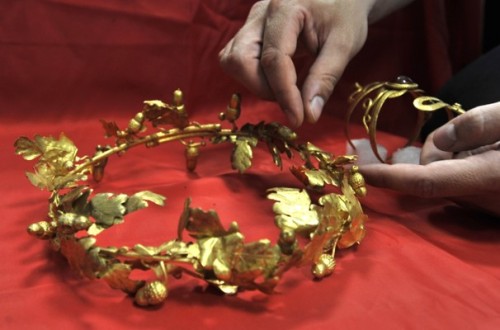
Earlier in June two men were arrested for allegedly smuggling an ancient gold wreath and armband out of the country:

The suspects were stopped by highway police near the village of Asprovalta, some 40 kilometers (25 miles) east of Thessaloniki late Thursday. Officers, who were working on a tip that the house painter might be trafficking in antiquities, found the 4th century B.C. artifacts in a shoebox under the passenger seat. The wreath was a rare and valuable find, said Nikos Dimitriadis, head of the Thessaloniki police antiquities theft section. “It is a product of an illegal excavation from a Macedonian grave, according to archaeologists (who examined it),” he said.

  1. Associated Press, 2 arrested in Greece for alleged antiquities smuggling of ancient gold wreath, armband, The Washington Post, June 8, 2012, http://www.washingtonpost.com/world/europe/2-arrested-in-greece-for-alleged-antiquities-smuggling-of-ancient-gold-wreath-armband/2012/06/08/gJQAijagNV_story.html.

Rabu, 02 Mei 2012

Arrests in the Fitzwilliam Theft

There are reports that between two and six individuals have been arrested in connection with the theft of 18 Chinese objects from the Fitzwilliam Museum in Cambridge. The theft was the subject of BBC's Crimewatch Tuesday:

The stolen pieces had been given as gifts or bequests to the museum, with some experts estimating the artifacts to be worth approximately £18 million (about $28.7 million Cdn). None of the artifacts has been recovered. Police sought help from the public through a segment on the BBC-TV program Crimewatch on Tuesday evening. The show aired closed-circuit camera footage of four suspects sought in conjunction with the robbery.
As Dick Ellis explained in an interview last week, these thieves probably saw the booming trade in Chinese artworks, and may not have understood how difficult an eventual sale would be. Much in the same way similar objects were stolen from the Durham museum.

17th Century jade "imaginary beast" stolen from Fitzwilliam MuseumNoah Charney speculated last week that the stolen objects will be "smuggled [to China] . . . for in China the general rules about not purchasing art without performing Due Diligence and checking stolen art databases do not apply. Provenance is far less of an issue, sometimes for cultural reasons, but also for practical ones–Internet black-outs mean that many in China could not check stolen art databases, even if they were inclined to do so." I'm not sure that will be the case.

The Chinese have—on paper at least—the most regulated art market in the world, with a tiered series of regulation. It is one of the only sets of regulations which puts direct regulation in the art market, at the point of sale. Are there problems and corruption? Perhaps. But what art market—whether its in Rome, Paris, London, or New York is not corrupt?

In 2002, the Standing Committee of the National People’s Congress passed the Law on the Protection of Cultural Relics. The 2002 Law legalizes private transactions involving cultural relics in five circumstances, (1) legal inheritance or gift; (2) purchase from cultural relics shops; (3) purchase from cultural relics auction enterprises; (4) exchanges or transfers between individual citizens; and (5) other methods authorized by the central government. Many of these transactions take place at officially sanctioned cultural relics shops and auction enterprises; and the 2002 Law prohibits a cultural relic shop from running an auction and vice versa.

Under Article 58, the government may buy any cultural relic submitted to a mandatory inspection before sale pursuant to Article 56. During this mandatory inspection, under Article 56, the government is given a kind of right of first refusal, with the purchase price determined by the government representative. Pursuant to article 57, in the event of a sale to a private individual, a report is produced, effectively tracking the buyers and sellers of cultural objects. This new regulatory framework seems a very aggressive strategy, and one that, if implemented effectively, could positively impact the illicit trade in China. However, implementing this strategy may be difficult and subject to corruption.  And yet by recording who buys what, it may be possible not only to track the chain of title of specific cultural objects, but also to evaluate whether individuals are routinely buying and selling stolen, looted, or suspicious objects. What other nation does this routinely? Perhaps the Italian Carabinieri, but that may be it.

Many in the West have an immediate reaction to all things China. And I think that quote above does not really convey the reality of the Chinese art market. Prof. Paul Bator remarked in 1983 that China was the great under-researched area of the world when it comes to sources of heritage theft (he called it art theft). Despite s few reports, that is still the case. We can blame the Chinese for other problems perhaps, but the Chinese art market does not I think bear the collective guilt for the Fitzwilliam theft. Rather it seems to be a more homegrown set of thieves from East London.
  1. He Shuzhong, Protection of China’s Cultural Heritage, 5 J. Art, Antiquity & L., 19 (2000).
  2. J. David Murphy, Plunder and preservation : cultural property law and practice in the People’s Republic of China, (1995), http://www.bcin.ca/Interface/openbcin.cgi?submit=submit&Chinkey=204154 (last visited May 2, 2012).
  3. Andrew Jacobs, China Hunts for Art Treasures in U.S. Museums, The New York Times, December 17, 2009, http://www.nytimes.com/2009/12/17/world/asia/17china.html?_r=2&hp (last visited Dec 17, 2009).
  4. Peter Foster, China to study British Museum for looted artefacts, Telegraph.co.uk, October 19, 2009, http://www.telegraph.co.uk/news/worldnews/asia/china/6374959/China-to-study-British-Museum-for-looted-artefacts.html (last visited Oct 20, 2009).

Senin, 10 Oktober 2011

$150 Million worth of art in the trash?

Stolen to order?
Nature Mort au Chandelier, Fernand Léger, 1922
Last week it was reported that three individuals were arrested in connection with the theft of five works from the Musée d'art Moderne in Paris. The thefts took place in 2010 and there were reports that the museums alarms had been malfunctioning for months. Well the thieves may have had a very easy time stealing the art. There are reports that the five stolen works were destroyed, and that one of the works was stolen to order:


Detectives said that while they remained sceptical about his account, they could not "totally rule out" this catastrophic scenario. The destruction of such landmark masterpieces would be a major blow to international art heritage. The first to be arrested was a Serb known only as Vrejan T, 43, nicknamed "Spiderman" and who was detained days after last year's heist over a separate art theft from a chic Paris apartment. Under questioning, the suspect reportedly recounted how he loosened screws in a window at the Art Deco Palais de Tokyo housing the museum, returned a few nights later to remove the frame and sliced through a padlock on an iron grille. He had initially gone there only to steal a Léger work to order, he said, but once inside, was "surprised" when the burglary alarm failed to sound. Being a "veritable art lover," the Serb told police he then wandered around for another hour, eluding 30 closed circuit cameras to cherry pick four other masterpieces. "He found the Modigliani the most beautiful of all," a judicial source told the JDD. Vrejan T reportedly told investigators he had stolen the Léger for Jean-Michel C, 56, an antiques dealer with a shop called Antiquités Bastille. He was arrested in May for selling other stolen art works.
As a wise Museum Security Director once said: 'shit happens'. Lets hope this is the statement of a desperate defendant, and the paintings are still safe. This underscores the point that tracking down art thieves is a delicate proposition. They have a very big piece of collateral, in this case five important works of art. If you prosecute the thief too harshly, you run the risk of destroying what you were after. Of course the best way to prevent this destruction would have been better basic attention to security.

  1. Henry Samuel, £100m masterpieces stolen from French museum “crushed by rubbish truck,” The Telegraph, October 9, 2011, http://www.telegraph.co.uk/culture/art/art-news/8816634/100m-masterpieces-stolen-from-French-museum-crushed-by-rubbish-truck.html (last visited Oct 10, 2011). 
The other stolen works:


La Pastorale, Henri Matisse, 1906
L'Olivier pres de l'Estaque, Georges Braque, 1906


The Pigeon with Peas, Pablo Picasso, 1911-12
La femme a l'eventail, Amadeo Modigliani
   

Selasa, 04 Oktober 2011

Three arrested in connection with thefts from Musee d'Art Moderne

In May 2010 five works were stolen from the Musee d'Art Moderne near the Eiffel tower. Now three individuals are being detained in connection with the thefts, though the works are still missing. From AFP:


The Pigeon with Peas, Pablo Picasso, 1911-12
The three, a woman suspected of taking part in the theft and two people suspected of handling stolen goods, were arrested and charged over the robbery of the five paintings, by Henri Matisse, Pablo Picasso, Georges Braque, Ferdinand Leger and Amedeo Modigliani, and placed in custody on September 16, the official said. A lone burglar sheared off a gate padlock and broke a window to get into the city-run Musee d'Art Moderne in the brazen operation during the night of May 19 last year. The paintings were found to be missing just as the museum, a major tourist attraction near the Eiffel Tower, was about to open. Paris mayor Bertrand Delanoe later said one of the museum's alarms had been "partly malfunctioning" since the end of March, and that it was still awaiting repair when the thieves struck.


Kamis, 09 Juni 2011

Looting with Dynamite in Greece

This is the first I've head of using dynamite like this to loot sites: six looters in northern Greece have been arrested for using dynamite at an archaeological site to search for gold:


Authorities said Thursday that the four Greek and two Albanian men were arrested Wednesday after police discovered a 12-meter (40-foot) tunnel blasted into the side of a mountain near the city of Kavala, 700 kilometres (435 miles) north of Athens. 
The tunnel, with support columns and a construction track, was first started in 2008, according to local police, who said the suspects would be charged with illegal excavation, illegal use and possession of explosives, and violating archaeological protection laws. 
Archaeological services would not comment on whether they believed there was buried gold in the area.

Senin, 25 April 2011

"He really loves art. . . "

This is what an art thief looks like.
". . . but also the money that he can get from it".

So says an unnamed source describing the notorious Stéphane Breitwieser who stole 240 works of art, went to prison, wrote a memoir and has been arrested again in his home:

At Breitwieser's home, police discovered about 40 paintings, three sculptures, and a tapestry, French newspaper Le Parisien reports. At Breitwieser's mother's place, cops also found a landscape by a Brueghel pupil that had been stolen from a Brussels museum. Several valuable objects, including chandeliers and pocket watches, were also discovered in the pond next to Breitwieser's mother's house. In the past, she destroyed several paintings in order to protect her son, and also hid his stolen artworks along a highway, in a canal, and even in a neighbor's chicken coop.

  1. Police Nab Europe’s Most Notorious Art Thief — And His Mom, Too, ARTINFO France, April 25, 2011, http://www.artinfo.com/news/story/37537/police-nab-europes-most-notorious-art-thief-and-his-mom-too/ (last visited Apr 25, 2011).

Selasa, 18 Januari 2011

Looted Statute (maybe Caligula) Seized Near Rome

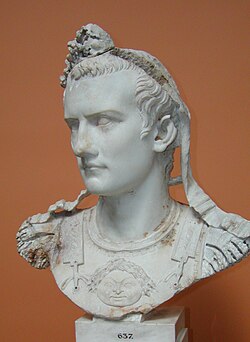
A Bust of Caligula at the Ny Carlsberg Glyptotek
Italian police have arrested a tombarolo with an 8-foot ancient statue not far from Rome. The statue may be worth €1 million. They believe the statue may be of Caligula, and may even have been looted from Caligula's tomb, which has not been discovered. We surely won't know if this tomb or the site was the actual tomb, but if looting is destroying the archaeological record, we are losing information.

Might the record have given us information on Caligula, who may have received a bad rap from the sources which have survived antiquity? Contemporaries describe the emperor as insane, saying he appointed a horse as consul, slept with his sisters, and killed often. But these might have been claims made by his political enemies in the senate and elsewhere—perhaps not too different from today's politics. After all, how could the son of Germanicus (my favorite Roman) have been such a bad guy. Caligula only ruled from AD 37-41, before he was assassinated.

I wonder where this statue was going to be sold? The United States, the middle-East, Asia? Excavations will start to reveal the archaeology of the site where the tomb raider unearthed the massive statue.

  1. Tom Kington, Caligula's tomb found after police arrest man trying to smuggle statue, The Guardian, January 17, 2011, http://www.guardian.co.uk/world/2011/jan/17/caligula-tomb-found-police-statue (last visited Jan 18, 2011).

Jumat, 13 Agustus 2010

Ancient Underground Tomb Discovered in Looting Raid

AP Photo:  Turkish Culture Minister Ertugrul Gunay
 Authorities in Turkey have discovered an "important archaeological site" while searching for looted antiquities, reports the Associated Press.  The discovery was made near Milas, in western Turkey.  This sarcophagus may have contained artifacts, but they have disappeared, likely lost in the illicit trade.  The piece describes the tunnels:

[T]he suspects had dug two tunnels — 6 and 8 meters (yards) long, from the house and an adjacent barn, leading to the tomb that is buried some 10 meters (yards) deep.
They used sophisticated equipment to drill through the thick marble walls of the tomb and were working to remove the coffin from the underground chamber when they were detained, according to the Culture Ministry.
"I would have wished that this (archaeological find) had been discovered through our digs and not through digs conducted by a band of treasure hunters," Anatolia quoted Gunay as saying.
"This is not an ordinary treasure hunt. It is very organized and it is obvious that they received economic and scientific help," Gunay said, adding that Turkey also would investigate the suspects possible overseas links.

  1. Turkey Discovers Ancient Underground Tomb : NPR, , http://www.npr.org/templates/story/story.php?storyId=129174682 (last visited Aug 13, 2010).

Selasa, 30 Maret 2010

Two Guilty Pleas in Four-Corners Antiquities Investigation

On Monday two pleaded guilty to stealing government property and violating the Archaeological Resources Protection Act.  Both Brent Bullock and Tammy Shumway had been among those indicted during a federal investigation into looting Native American sites in the Four Corners region in the Southwest.  From the AP:


Bullock, 61, sold several ancient Indian items to an undercover operative in 2007, including a blanket fragment for $2,000 and a hoe-like tool for $500, according to court documents. He also offered to sell several ceramic figurines taken from U.S. Bureau of Land Management land.

Bullock said he wanted to sell the items because he was in debt, according to a search warrant affidavit.

Investigators said Bullock acknowledged to the informant that the items came from public land in Utah but filled out paperwork saying they were from private land in Colorado.

Shumway, who introduced Bullock to the informant, was charged because the 40-year-old woman aided and abetted the deals and signed a falsified paper about the items' origin as a witness, federal officials said.

In U.S. District Court on Monday, Bullock and Shumway acknowledged they knew the items had been illegally dug up from public land in Utah. As part of a plea deal, they each pleaded guilty to one count of trafficking in stolen artifacts and theft of government property. Prosecutors agreed to seek a reduced sentence. 

A couple points which might not be evident from some of the coverage of these plea deals.  First, sentencing will occur in July; and the AP piece notes the maximum sentence is 12 years in prison.   Neither of these defendants will likely receive anything close to the statutory maximum.  That is because when a defendant enters into a plea deal, they do so in most cases to achieve a recommendation from prosecutors on sentencing; which will often fall far below the maximum sentences.  This should not be construed as authorities in the United States not taking these crimes seriously—rather a reflection of the general criminal procedures when plea agreements are reached. 

Second, Tammy Shumway is the widow of Earl Shumway, a notorious antiquities looter.  Shumway became a national figure in the 1980's, who boasted that he began looting at three years old with his father.  He sold a large collection of over thirty prehistoric baskets and sold them for a great deal.  Though he was prosecuted for selling those baskets, he cooperated with authorities and only received probation.  He went right back to looting, using a helicopter and even lookouts to avoid authorities.  He boasted to the media that he could never be apprehended.  Though he was not caught in the act of looting, authorities did secure a conviction using DNA evidence found on Mountain Dew soda cans he left in the areas he looted.  In 1995 he received a 5-year prison sentence which sent a message that Federal agents and prosecutors took this kind of crime seriously. 

  1. Timothy Egan, In the Indian Southwest, Heritage Takes a Hit, N.Y. Times, November 2, 1995.
  2. Mike Stark, 2 Utahns plead guilty in sweeping artifacts case, AP, March 29, 2010.

Senin, 25 Januari 2010

Cyprus Antiquities Smugglers Discovered


Police in Cyprus have detained ten people over the weekend and are looking for five more after the discovery of an international antiquities-smuggling ring believed to be the largest such discovery in Cyprus's history.  The objects seized may be worth more than 11m euros, and include pottery, coins, figurines, some of which may be 4,000 years old.  Many of the objects may have originated elsewhere, and authorities now are attempting to determine the origins of many of the objects.  The BBC points out that Cyprus was an important crossroads in the ancient Mediterranean, with armies and merchants from Egypt, the Roman Empire, Persia, and others.  This may make it difficult to trace the origin of these objects, many of which could plausibly have originated from dozens of modern-day nations.  The smugglers of course were likely to have disguised or destroyed any evidence of the history of these objects. 

  1. Cyprus smuggling ring broken up, BBC, January 25, 2010.

Selasa, 08 Desember 2009

Update on the Drouot Arrests

The AP reported yesterday that charges have been filed against nine employees of the Drouot auction house. French authorities last week found a stolen work by Gustave Courbet.

An auctioneer and eight commission agents were given preliminary charges, including ''organized theft,'' the prosecutor's office said.
Three others detained last week in the police raids on Drouot, its warehouses and homes of employees were released with no charges filed against them.
When the bust was announced last week, there was initial confusion about which Courbet work had been recovered. The painting -- stolen several years ago from a collection whose owner had recently died -- was not clearly identified, and the heir had confused it with another work, an official close to the inquiry said. He spoke on condition of anonymity because the case is ongoing.
Police initially identified the recovered Courbet work as ''La Vague'' (The Wave), worth euro900,000 ($1.3 million), but officials said Monday it was actually ''Paysage marin sous un ciel d'orage'' (Marine Landscape Under a Stormy Sky), worth about euro100,000.
The stolen Courbet -- one of several paintings by the convention-smashing realist master with a stormy ocean theme -- was found at the home of one of the commission agents being investigated. Other pieces recovered in the sweep included artworks, frames and furniture.
Under French law, preliminary charges give the judge more time to investigate and determine whether to send the case to trial. Three commission agents were jailed in the case, with the prosecutor's office accusing them of deep involvement in thefts dating back to 2001.
The auctioneer was released pending the investigation with the stipulation that he stop hosting sales.

  1. The Associated Press, Preliminary Charges vs 9 in Paris Auction Sweep, The New York Times, December 7, 2009.

Rabu, 02 Desember 2009

Paris Auction House Searched


In more news which seems to reflect poorly on the French art trade, the AP is reporting that 12 people have been "detained" from the Hotel Druout auction house in Paris.  Police found a stolen Courbet painting, the Wave, which was stolen in 2004.